


What Is the Difference Between a ‘Regular’ CPA vs a Dedicated Tax Strategist?
Physicians often experience sticker shock when they file their annual taxes, and we often see questions in our online physician communities about how members can reduce their tax burden. Similarly, we sometimes get questions from members who have reached out to a tax strategist and get sticker shock on the quote and wonder if it’s worth it. A tax strategist can be a great resource for physicians looking for more in-depth, personalized, ongoing proactive tax planning rather than just an annual check-in for tax preparation services, but it's important to understand the services they offer over a regular CPA and whether that would be of benefit to you before making the monetary and time commitment to work with one. Below, we cover the key differences between a tax strategist vs a CPA, and provide you with resources to determine if you may benefit from working with a tax strategist.
The information for this article is derived from original material contributed by our partners at Physician Tax Solutions, who provide a unique, proactive approach to tax strategy specifically tailored for physicians. Their approach uses tax-efficient methods to accumulate wealth through specialized entity structures and tax-advantaged strategies. Use our partnership link to book an intro call today if you believe you could benefit from proactive tax planning based on their guidance below.
Disclosure/Disclaimer: This page contains information about our sponsors and/or affiliate links, which support us monetarily at no cost to you. These should be viewed as introductions rather than formal recommendations. Our content is for generalized educational purposes. While we try to ensure it is accurate and updated, we cannot guarantee it. Rules/laws can change frequently. We are not formal financial, legal, or tax professionals and do not provide individualized advice specific to your situation. You should consult these as appropriate and/or do your own due diligence before making decisions based on this page. To learn more, visit our disclaimers and disclosures.
Is a tax strategist just another name for a fancy accountant, or is there a big difference between the two titles?
While many accounting firms do offer tax strategy as a portion of what they do, and there’s certainly an overlap between CPAs and dedicated tax strategists, they tend to operate at different depths on their respective areas of expertise.
The focus of most accountants or tax preparers is on preparing the tax return properly based on the information provided to them at the end of the year. Remember, by the time a tax year is already over, many of the biggest tax planning choices are already locked in for that year. At a high level, this means that a CPA or tax preparer’s primary responsibility is to report what already happened to the IRS to accurately calculate your tax burden and file your taxes.
A tax strategist, on the other hand, is supposed to shape and plan for what will happen in the next year and beyond to reduce your future tax liability.
What a Certified Public Accountant (CPA) or other tax return preparer does
The work a CPA, Enrolled Agent, or other tax return preparer does is very important. Taxes are complicated, and messing up on your tax returns can create lots of headaches, fees, and penalties. A good tax preparer who is diligent and accurate can save you from mistakes, missed forms, and filing issues that create bigger problems later.
You need someone who understands the tax code and rules relating to a tax return. The training and education CPAs and Enrolled Agents receive is almost entirely focused on tax return compliance, and the accurate and timely filing of tax returns. They spend a lot of time making sure to put the right information on the right line on a tax return, and do this over and over again during the tax return filing season. Once the tax season is over, many stay busy getting up to date on the latest tax return changes and information provided by the IRS.
Some of their many responsibilities include:
Preparing and filing tax returns
Ensuring compliance with IRS rules
Handling bookkeeping and financial statements
Representing you in audits, should they occur
Giving some tax advice for questions you ask and perhaps giving some advice to plan for the future
Due to the ever-changing complexity of the tax laws and strict filing deadlines, as well as the relatively lower fees for tax prep alone, many often have little time to engage in proactive tax planning with each of their clients given the large number of clients they have.
Related PSG resources:
The role a tax strategist plays
A good tax strategist typically starts with an initial comprehensive tax strategy plan based on your situation, goals, and challenges, and then updates it on at least an annual basis. This is done proactively rather than assessing your situation reactively come tax time.
Providing tax planning advice and strategies in the role of a tax strategist requires additional training and education beyond the level required to be a tax return preparer. Tax strategists often have advanced designations from credible organizations or advanced degrees. They are often familiar with things like alternative investments, real estate, estate planning, business formation and entity structures, and other niche areas of the tax code.
With this knowledge and the dedicated budget/focus, they are able to do things such as:
Do future projections and modeling to design forward-looking tax plans
Help restructure income, businesses, or investments in the most advantageous way
Identify legal ways to minimize taxes through entity structures, tax credits, and tax deductions
Work with you year round to ensure all the pieces are working correctly and you’re always planning ahead
Make sure that you stay in compliance with legal requirements, documentation, and other necessary aspects of implementing your tax plan
Coordinate with CPAs, attorneys, estate planners, and financial advisors
As you can see, a tax strategist will be much more involved in your financial and business life, beyond just what needs to go into a tax return to accurately report your earnings.
Related PSG resource:
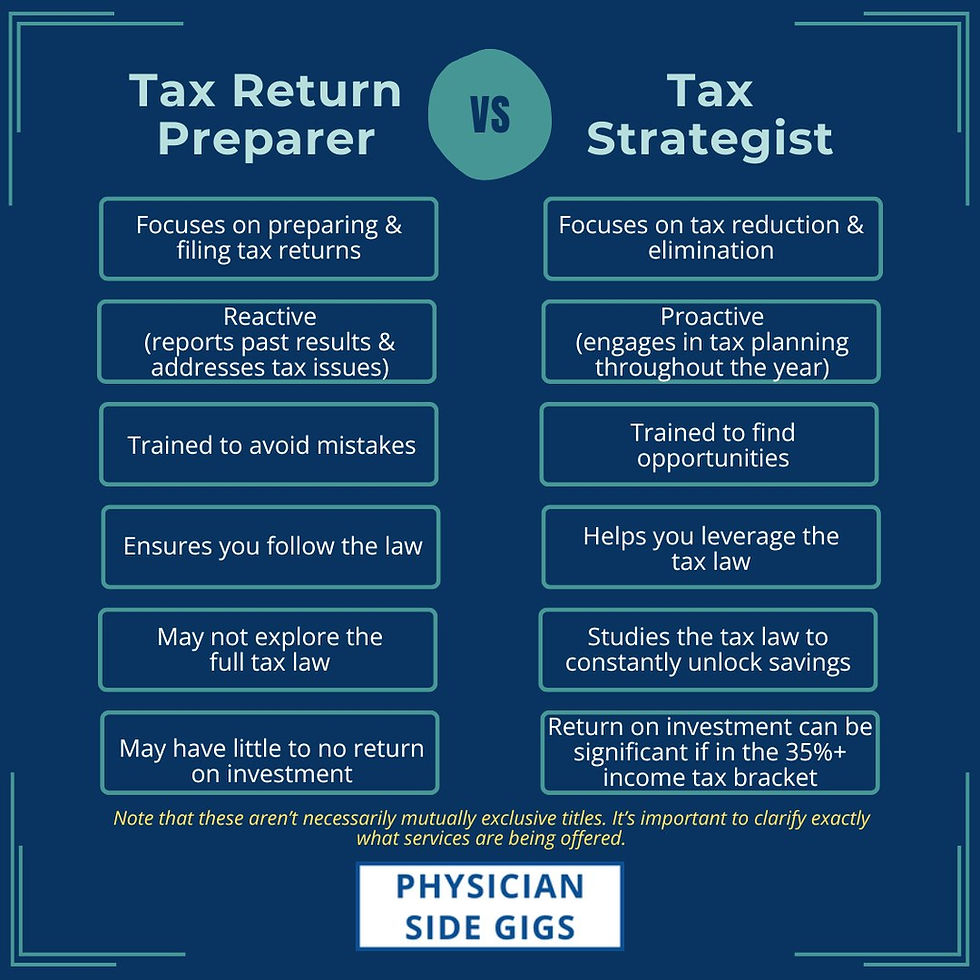
CPA or other tax return preparer vs tax strategist
Let's break down the main differences between the two head to head, generally speaking.
Tax Return Preparer | Tax Strategist |
|
|
|
|
|
|
|
|
|
|
|
|
|
|
|
|
Again, it’s important to note that these aren’t necessarily mutually exclusive titles. A tax strategist may also serve as your tax return preparer, and some tax return preparers may offer some tax planning services (though you’ll always want to clarify what exactly those services entail).
Related PSG resource:
Who is a tax strategist a good fit for?
There are nuances when it comes to taxes, but in general, tax planning can often make sense for doctors when:
You have a W-2 income over $750,000
Your spouse’s and your taxable income is over $600,000, and you or your spouse receive 1099 income
You own an active business
You have real estate investments

We’ve covered this in more detail in a dedicated article on who is a tax strategist a good fit for?
The fact is that at W2 amounts below the threshold above (and without a business, self employed income, or real estate), the tax code doesn't offer much in the way of opportunities for tax strategy beyond maximizing tax advantaged accounts, such as retirement accounts, and other relatively standard deductions. The costs of a tax strategist are unlikely to significantly outweigh the deductions a tax strategist can find for you, and therefore, most people in this situation may want to save their money on more expensive accountant options.
Learn more about tax strategy for doctors earning only W2 income.
There are many more strategic options for physicians earning 1099 income, who own a business, or who are investing in real estate. Learn more about tax strategy for physicians earning 1099 income and the tax benefits of real estate investing.
Conclusion
A tax strategist can often offer more tax planning and proactive strategy than what other tax professionals can, given their time, cost, and expertise. That said, not every physician will necessarily benefit from a tax strategist, so it's important to understand if you fall into a category where you should consider working with a tax strategist. If you're a very high income physician, or if you have a business, significant 1099 income, or are involved in real estate, the benefits become more clear.
Additional tax planning & tax preparation resources for physicians
Explore our directory of accountants and tax strategists for doctors to find options based on your specific situation.
Sign up for our weekly PSG newsletter for alerts on new educational content, free webinars, and more.
Explore related PSG content: