


Would I Benefit From Using a Tax Strategist?
Have you wondered why your tax return preparer does not give you tax advice or strategies to reduce the amount of taxes you pay? Or, if they do, why they only provide it when you ask them about something you heard about somewhere else? Many physicians and high income families are eager to reduce their tax burden. We get questions daily on our online physician communities asking for recommendations for accountants that can help with tax strategy, often after being disappointed with their tax bill. It’s important to know, though, that it doesn’t always make financial sense for a physician to use a tax strategist, and a lot depends on the type of income you earn, the amount of income, and your personal willingness to introduce complexity into your accounting. Below we’ll cover the differences between a ‘normal’ CPA and one that specializes in tax strategy, whether your situation is one that a tax strategist is likely to be able to help with, as well as what you should know about working with a tax strategist.
The information for this article is derived from original material contributed by our partners at Physician Tax Solutions, who provide a unique, proactive approach to tax strategy specifically tailored for physicians. Their approach uses tax-efficient methods to accumulate wealth through specialized entity structures and tax-advantaged strategies. Use our partnership link to book an intro call today if you believe you could benefit from proactive tax planning based on their guidance below.
Disclosure/Disclaimer: This page contains information about our sponsors and/or affiliate links, which support us monetarily at no cost to you. These should be viewed as introductions rather than formal recommendations. Our content is for generalized educational purposes. While we try to ensure it is accurate and updated, we cannot guarantee it. Rules/laws can change frequently. We are not formal financial, legal, or tax professionals and do not provide individualized advice specific to your situation. You should consult these as appropriate and/or do your own due diligence before making decisions based on this page. To learn more, visit our disclaimers and disclosures.

Article Navigation
What are the differences between a Certified Public Accountant (CPA) or other tax return preparer and a tax strategist?
When picking your accountant, it’s important to understand the difference between a firm that specializes in and focuses on tax strategy versus an accountant or tax preparer that may be able to weigh in on tax questions or planning, but who primarily focuses on filing a tax return.
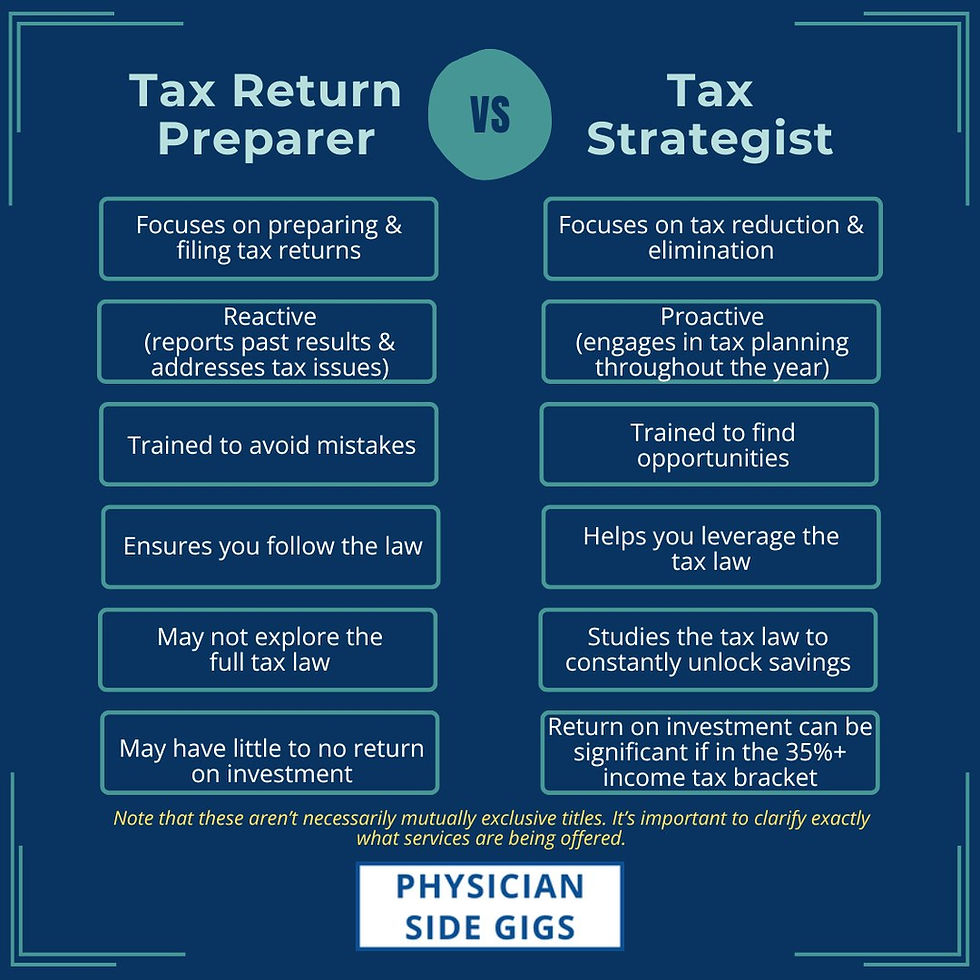
While the distinction is not always clear cut, here is a simple way to look at the difference between the main objectives of a tax return preparer and a tax strategist:
A tax return preparer focuses on the numbers from the past year. They are looking through the “rear-view mirror” and recording the financial history of the past year.
A tax strategist looks forward through the “windshield” to where you’re going, and proactively helps you make decisions during the year and in the future so that your tax liability is lower when it is time to file your tax return.
There are, of course, hybrid options. Many CPA or accounting firms offer tax planning or tax strategy, and provide basic guidance or strategies. For a lot of physicians who have primarily W2 income or who have a small amount of 1099 income, the options for tax strategy may be limited, and therefore these firms are a great option.
However, there is a subset of physicians who may benefit heavily from a deeper investment of both time and money in tax strategy, and it is these physicians who may want to consider working with a company whose primary focus is on tax strategy, though they may also file your tax returns. When making this decision, it’s important to understand how much you personally could benefit from tax strategy, and how proactive you want to be about looking ahead, potentially far into the future, for ways to reduce your tax liability.
My accountant says they provide tax strategy, but why aren’t they discussing the same tax options as I’m hearing about elsewhere?
There are multiple potential reasons for this. One is that you may not qualify for some of these advanced tax strategies, or even if you do, your accountant may feel that the lemon isn’t worth the squeeze for the extra effort, paperwork, or compliance required. Another is that this may not be within the scope of the services that they provide to clients at the rate that you’re contracted for, and therefore it isn’t what the accountant was hired to do.
Or, it may simply be that the tax return preparer isn’t specifically trained to provide tax reduction strategies or stay up to date with the nuances of some of these strategies. A tax strategist requires additional training and education beyond the level required to be a tax return preparer, and often holds an advanced degree or advanced designations from credible organizations, i.e., Masters, JD, LLM in Taxation; and designations, i.e., CPA, PFS, CTP, CTS. Additionally, a tax strategist is always studying the tax law and changes in the law to find new ways to unlock savings and stay in compliance.
For more details and depth, read our dedicated article about the differences between a dedicated tax strategist and a CPA.
When does it make sense for a physician to work with a tax strategist?
There are nuances when it comes to taxes, but in general, tax planning can often make sense for doctors when:
You have a W-2 income over $750,000
Your spouse’s and your taxable income is over $600,000, and you or your spouse receive 1099 income
You own an active business
You have real estate investments
The nuances in the tax code really favor self-employed, business, and real estate income. At W2 amounts that are lower than the threshold above (and without other forms of income), there likely aren't enough options for tax strategy where the lemon is worth the squeeze to justify the costs, time, and complexity wtih using a dedicated tax strategist. Your normal CPA can likely advise you on things like maximizing tax advantaged accounts and other relatively standard deductions.
Learn more about tax strategy for doctors earning only W2 income.
Conversely, there are many nuances in the tax code for businesses, 1099 income, and real estate investing. Along with these nuances come areas for optimization and strategy for leveraging the tax code to decrease your tax burden, and this is where a tax strategist can make a lot of sense (some examples discussed below). Learn more about tax strategy for physicians earning 1099 income and the tax benefits of real estate investing.
The higher the income, the more proactive tax planning makes sense, but it comes down to a number of factors. Physicians who often benefit the most from working with a tax strategist are the ones who:
Are looking for more potential personal, investment, and business income tax savings
Lack a tax advisor who has advanced tax training and education on tax strategies that apply to high-income earners
Lack guidance from their tax advisor on ways to proactively reduce their taxes each year
Have an out-of-date tax saving strategy that isn’t regularly updated or aligned with their personal, financial, and retirement planning goals
Have an imbalanced mix of tax-deferred, tax-free, and long-term capital gain investments, limiting overall tax efficiency
If even some of these are true in your situation, you may benefit from working with a tax strategist.
Do I need proactive tax planning?
The following is a personal assessment based on the factors above that can help you determine if you are a candidate for proactive tax planning provided by a tax strategist.
On a scale of 0 to 5, where 0 means you least agree and 5 means that you most agree with the statement, rank the following statements:
Rank (0 to 5) | |
| |
| |
| |
| |
| |
Total Score |
If your total score is 15 or less, and you have either (i) a W-2 income over $750,000, or (ii) your spouse’s and your taxable income is over $600,000, and your spouse or you receive 1099 income, own an active trade or business or investment real estate, then you may benefit from working with a tax strategist.
Related PSG resource:
Am I willing to introduce some complexity into my financial life?
Though this is not always the case, utilizing sophisticated tax strategies may involve introducing more complexity into your financial life. This may mean things like having to:
Restructure your business
Rethink about how you structure your income
Incorporate more complicated estate planning techniques
Time your income and expenses strategically
Make investments that come with deductions or credits
Reassess how you do charitable contributions
Introduce new entities that complicate your banking or investing
A tax strategist will work with you to ensure that everything is documented properly in the case that an audit occurs (and of course, to make sure that everything is within legal boundaries). The goal is to work within the IRS’ framework to unlock benefits of different aspects of the tax code, rather than to find loopholes that aren’t allowed.
The cost of tax planning versus tax preparation, and what are the potential benefits of investing in a tax strategist?
Keep in mind that tax planning takes much more time and expertise than tax return preparation, and as a result, comes at a significantly higher cost. The expectation, though, is that the strategies will save you much more over time than you spend on the services. With the proactive strategy, however, the return on investment can be much higher, often to the tune of 10 times the cost of the investment if you meet the criteria above.
Our partners at Physician Tax Solutions offer a 10x guarantee on their tax planning engagement called the Strategic Tax Blueprint. If they don’t save you at least 10 times the fee in taxes during the first year, the blueprint fee is waived. You can learn more about their unique, proactive approach to tax strategy for physicians by booking an intro call through our partnership link.
If you are a candidate for working with a tax strategist, the earlier in the year to start the better. Most tax strategies must be implemented early in the year to maximize the tax savings.
Tax planning through financial advisors vs tax strategists
Many investment and financial advisors advertise they provide “tax planning” or “tax strategies”, but these strategies may involve selling other products or financial services. Be careful to distinguish between tax planners who are objectively providing tax strategies from those who are selling a product or financial service.
Related PSG resources:
Conclusion
While working with a tax strategist doesn’t make sense in all situations, if you’re a high-income earner that falls into the guidelines above and you’re looking for more proactive tax planning than what your current tax professional offers, having a proactive tax strategy can help you apply tax saving strategies to your broader financial goals. The most effective plan is often when your tax planning and tax preparation work together, either through a single, qualified professional or through a team of professionals working with your best interests in mind.
Additional tax planning & tax preparation resources for physicians
Explore our directory of tax preparers, accountants, and tax strategists for doctors to find options based on your specific situation.
Sign up for our weekly PSG newsletter for alerts on new educational content, free webinars, and more.
Explore related PSG content: