


What to Know about Skilled Nursing Facility (SNF) or Long Term Care (LTC) Physician Roles
We often get questions (or vents) in our online physician communities from physicians considering or working in skilled nursing facility (SNF) or long term care type (LTC) settings. This is a niche that many physicians aren’t familiar with, and often differs a lot depending on the exact facility. Accordingly, the responses can vary depending on a particular experience, though there are several common themes. Below, we discuss common themes, red flags, FAQs, and pointers for physicians exploring, or currently navigating, careers or side gigs in the SNF or LTC setting.
Disclosure/Disclaimer: This page contains information about our sponsors and/or affiliate links, which support us monetarily at no cost to you. These should be viewed as introductions rather than formal recommendations. Our content is for generalized educational purposes. While we try to ensure it is accurate and updated, we cannot guarantee it. Rules/laws can change frequently. We are not formal financial, legal, or tax professionals and do not provide individualized advice specific to your situation. You should consult these as appropriate and/or do your own due diligence before making decisions based on this page. To learn more, visit our disclaimers and disclosures.
Article Navigation
What to know before working in a SNF environment - is it really part time and low stress?
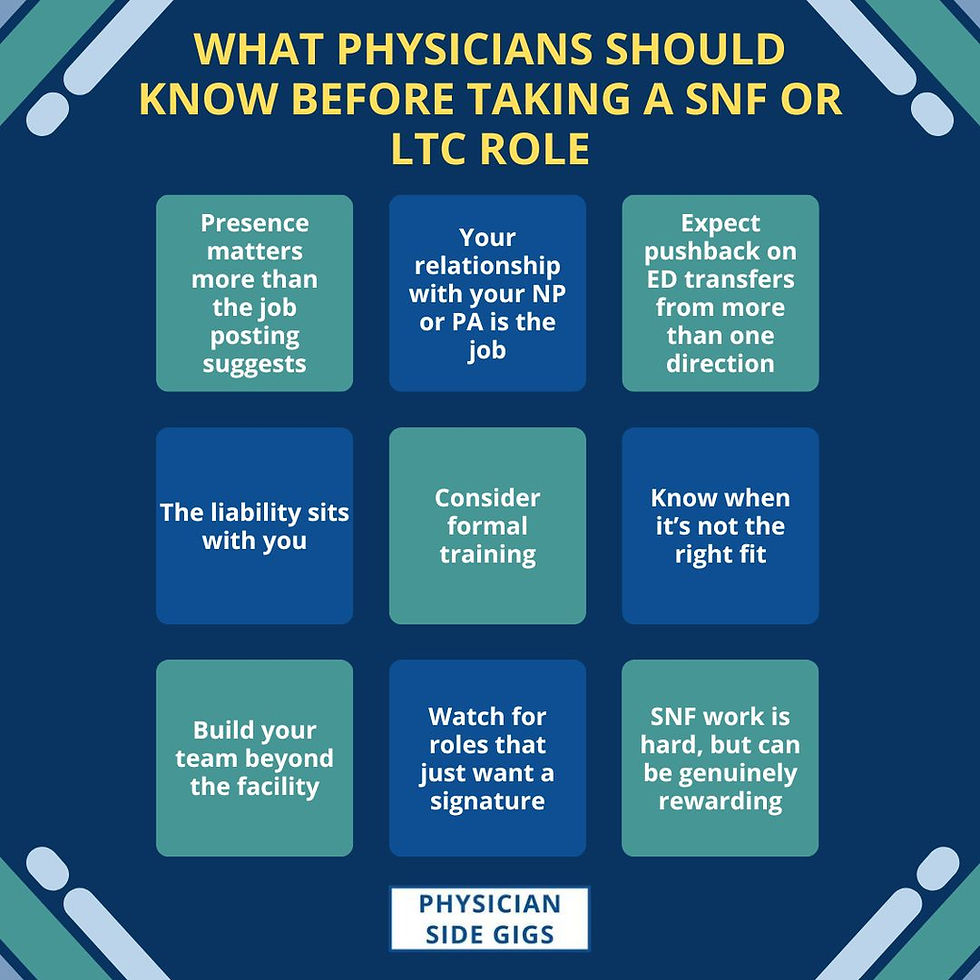
Presence on site at the facility matters more than the job posting may suggest
Your relationship with your NP or PA can make or break the job
Expect pushback on ED transfers from more than one direction
Build your team beyond the facility - bring in your colleagues!
What to know before working in a SNF environment - is it really part time and low stress?
Skilled nursing facility (SNF) and long-term care (LTC) medicine is often pitched to physicians as a lower-acuity, lower-stress alternative to hospital or clinic work. Job advertisements state that it may be a good fit for someone who wants more control over their schedule, or a way to supplement income with a part-time medical director role.
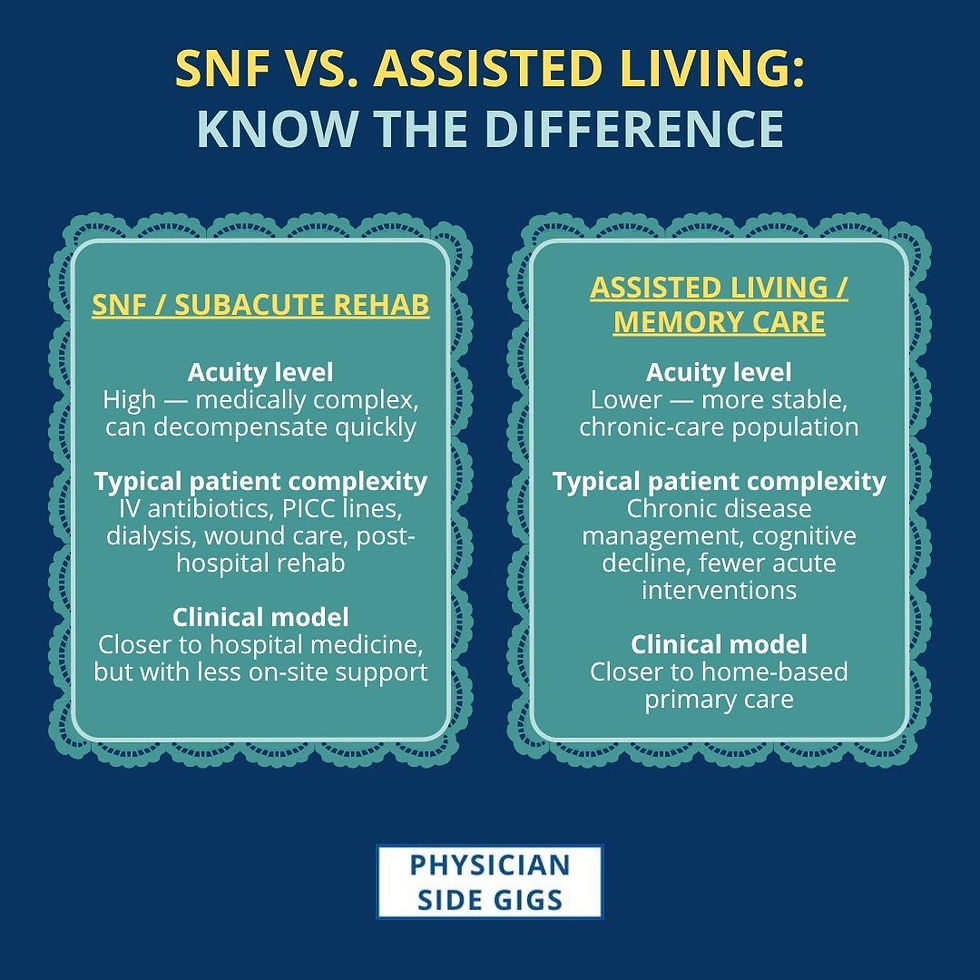
While some aspects of this may be true, many physicians in our communities don’t agree with the overall description. "Low acuity" is one of the more persistent misconceptions about SNF work, and physicians in our communities push back on it relatively hard. Patients end up in a SNF because they're sick — often elderly, comorbid, on multiple medications, and without the reserve to tolerate a missed diagnosis. Several physicians noted that hospital length-of-stay pressures mean patients are being discharged to SNFs sicker and faster than they used to be, with IV antibiotics, PICC lines, dialysis, and complex wound care now being common in the SNF setting rather than the exception. One physician pointed out that these patients can go from baseline to septic to deceased faster than almost any other population physicians manage.
Additionally, call burden can significant, so factoring this into both whether the lifestyle is a good fit, as well as compensation, is critical.
Understand the actual setting and role - the differences between SNF, post acute rehab, LTC, memory care, and nursing home
As many facilities in this space fill multiple roles instead of being purely tailored towards one need, it’s important to understand what you’re actually going to do, and what patient populations you’ll be responsible for. Common settings include:
Skilled nursing facility (SNF) post-acute rehab: patients are admitted after hospitalization for rehab, wound care, IV antibiotics, etc.; these are often higher acuity and have more turnover
Long-term care/memory care: residents may live there for months or years; tend to have more chronic disease, dementia, functional impairment, behavioral issues, and goals-of-care discussions
Nursing home: this can often combine both short-stay and long-stay residents, but is traditionally meant to have longer stay residents and have more chronic care management.
There are many different physician roles in these settings, likely depending on your specialty. Most of these roles, regardless of specialty, tend to be part time roles, but the extent of involvement may differ. You could be providing subspecialty coverage such as wound care or infectious disease, or you could be rounding a few days a week, covering admissions, doing telemedicine, or serving as a medical director.
The facility, the staffing model, the census, and your exact role will matter a lot in determining what you actually do on a daily basis, and what your experience is. The support systems will likely be the biggest factor - how much nursing support that you have, and how skilled those nurses are. Pharmacy support, therapist availability, social work and case management staff, and access to labs and other diagnostics, as well as other specialists, will also determine how much care management you’re able to provide in house as opposed to utilizing the hospital system when care needs escalate.
Presence on site at the facility matters more than the job posting may suggest
A recurring theme amongst physicians working in this setting is that although you may not be “required” to be on site very often, one day a week on-site isn't enough to really know a facility's residents, their families, or the staff you're relying on. Physicians who've done this work for years generally recommend two to three days a week of in-person presence, particularly early on, so you can build real relationships with the director of nursing, the charge nurses, and your midlevel team, and understand each resident's baseline well enough to notice when something's off.
Your relationship with your NP or PA can make or break the job
For medical directors who split coverage with a nurse practitioner or physician assistant, the quality of that working relationship was described as make-or-break. Physicians emphasized the importance of knowing and trusting your non-physician colleagues, setting clear expectations for when they should call or text you, and staying closely looped in on major decisions even if it means a higher volume of communication.
A practical way to build trust: periodic chart reviews
A concrete way to build that trust and catch problems early is to schedule periodic chart reviews together. Physicians in our communities suggest pulling a random sample of patients to walk through the management decisions as a pair. It's a way to either confirm you're doing well, catch things worth adjusting, or simply build the shared judgment that makes remote coverage days feel safer.
Expect pushback on ED transfers from more than one direction
Multiple physicians have described resistance when they wanted to send a resident to the emergency department, and noted that facilities are often navigating real pressure to protect their Medicare ratings and reputations, which can bias decisions toward keeping people on-site. Interestingly, more than one experienced medical director said the pushback they encountered from EMS was often greater than what they got from the facility itself, pointing to a broader gap between what hospitals and EMS assume a SNF can handle and what the facility can actually provide. The consistent advice: know your facility's real capabilities and limits, and be willing to advocate for the resident even when it creates friction.
The liability sits with you
Several doctors have been candid that SNF work can be more litigious than physicians expect, with more than one describing board complaints tied to SNF care despite long, otherwise complaint-free careers elsewhere. Because it's the physician's license on the line regardless of who wrote the order, staying closely engaged with your midlevel's decisions isn't optional — it's part of managing your own risk.
Consider formal training or certification in the space
Multiple physicians recommend the medical director training and certification offered through PALTmed (the Society for Post-Acute and Long-Term Care Medicine) as a starting point for anyone stepping into this role without prior SNF-specific experience. Attending a regional PALTmed conference has been mentioned as a high-yield way to get oriented quickly.
Know when it’s not the right fit for you
Not everyone who tries SNF or LTC work stays in it, and physicians in our communities have been matter-of-fact about that. Some found the setting too under-resourced relative to the complexity of the patients and transitioned back to hospital medicine or primary care. Others love the variety that they experience and the long term relationships that they build, as well as filling an underserved need and advocating for this patient population.
SNF/rehab vs. assisted living and memory care - always clarify the patient population and acuity
As alluded to above, physicians point out meaningful distinctions within post-acute and long-term care itself: assisted living and memory care populations are generally described as closer to home-based primary care, with lower complexity than a SNF or subacute rehab unit. If you're evaluating a role, it's worth asking specifically what mix of patients and acuity you'd actually be managing.
Build your team beyond the facility - bring in your colleagues!
Physicians in this space emphasize that specialist support — such as bringing in a PM&R physician for rehab-focused residents, or coordinating with hospice and wound care teams for patients with more complex needs — can meaningfully lighten the clinical load and improve care, especially in facilities without deep in-house resources.
Watch for roles that just want a signature
Many physicians have described being recruited into SNF positions where, in hindsight, the company seemed more interested in having a license to sign off on non-physician driven care than in a physician who intended to practice medicine and set clinical protocols. If you want to actually round, review charts, and shape how care is delivered, it's worth clarifying that expectation with the employer before you start — and watching for signs or red flags during the hiring process that they're not actually interested in that level of involvement. Also, interview the teams you’ll be working with and get a sense of how willing they are to work with you in the capacity that you would feel comfortable with.
SNF work is hard, but can be genuinely rewarding
Several physicians pushed back on the idea that SNF work is just a paycheck. They described it as some of the most meaningful medicine they practice, caring for a population that's often overlooked and treated with less dignity than it deserves. Getting to know residents and their families, being visible and present to staff, and advocating consistently for patients were described as the difference between being a director who's genuinely engaged and one who's just signing charts.
Conclusion
SNF and LTC medicine is frequently marketed to physicians as easy, flexible, and low-acuity — and just as frequently, physicians who've actually done the work say that's not accurate. Residents are medically complex and can decompensate quickly, oversight of midlevel-driven care carries real liability, and doing the job well typically requires more on-site presence and closer collaboration with facility staff than the position may be advertised with. If you're new to this setting, formal medical director training, deliberate relationship-building with your NP/PA and nursing leadership, and periodic chart review can go a long way toward closing the gap between what the role promised and what it actually requires — and toward figuring out whether it's the right fit for you at all.
Related career resources for physicians
Sign up for our weekly newsletter for alerts about side gig opportunities, upcoming related free webinars, additional educational resources, and more.
Related PSG resources: