


Are Nonclinical Jobs Really a Better Lifestyle, or Easier?
Almost daily in our online physician communities, we have posts submitted from a doctor saying that they are burned out and asking about nonclinical opportunities that they’d like to do instead for a better lifestyle. We understand the question - at first glance, the idea sounds promising: no overnight calls, no weekend rounding, no prior authorizations or charting, etc. Instead, you picture a laptop, a steady paycheck, and a job where you can work from home in your pajamas and get more time with your kids and pets.
But is it really that simple? Are nonclinical jobs really easier, and do they really provide a better lifestyle? Between salary cuts, working in the corporate world, and less flexibility and PTO, the reality of switching to a nonclinical career is much more nuanced. While these roles can solve some problems, they often introduce new challenges or other characteristics that are less preferable to some doctors. It may be that making changes in how you practice clinical medicine offers a better work life balance than switching to a nonclinical job. Before making a major career change, it’s critical to define what you're hoping to leave behind and what trade-offs you're willing to make.
Disclosure/Disclaimer: This page contains information about our sponsors and/or affiliate links, which support us monetarily at no cost to you. These should be viewed as introductions rather than formal recommendations. Our content is for generalized educational purposes. While we try to ensure it is accurate and updated, we cannot guarantee it. Rules/laws can change frequently. We are not formal financial, legal, or tax professionals and do not provide individualized advice specific to your situation. You should consult these as appropriate and/or do your own due diligence before making decisions based on this page. To learn more, visit our disclaimers and disclosures.
Article Navigation
What physicians usually mean by nonclinical jobs being “easier”
Where nonclinical jobs genuinely may offer a better lifestyle than clinical work
Where the “easier” or “better” lifestyle narrative for nonclinical careers falls apart
Examples of when clinical work many actually offer better work-life balance
What physicians usually mean by nonclinical jobs being “easier” than traditional clinical jobs
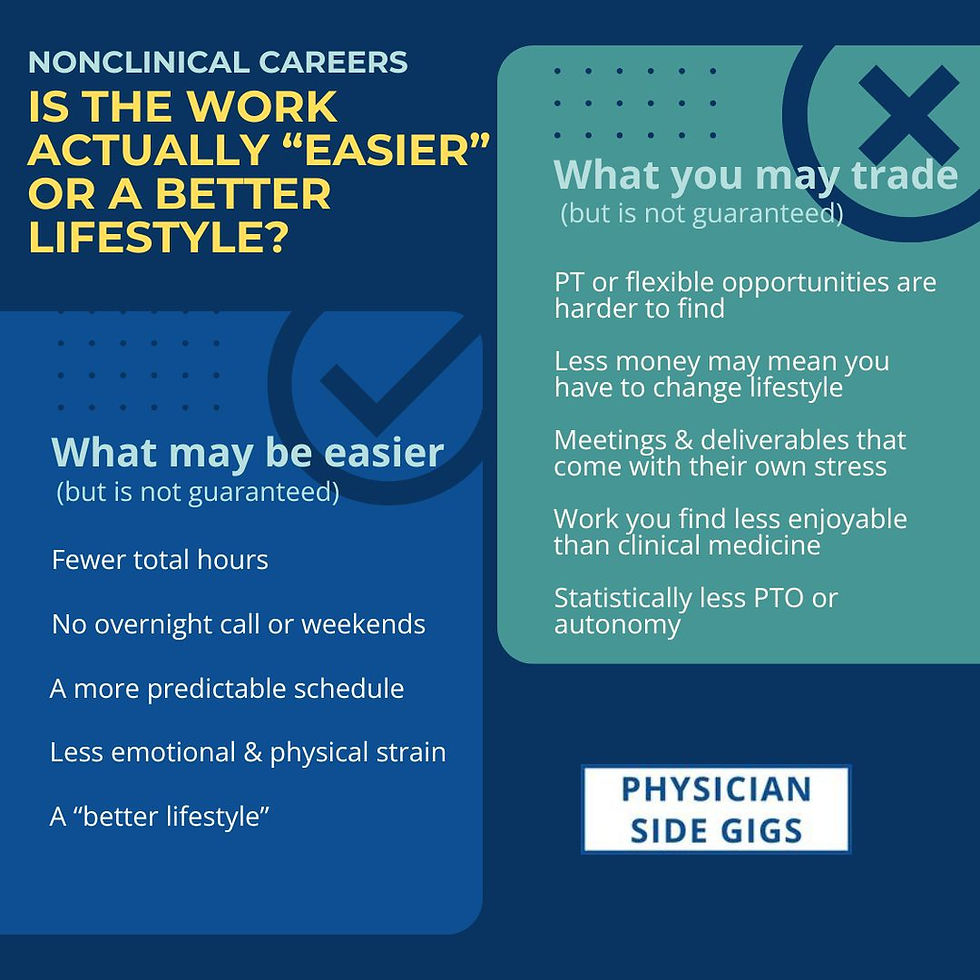
When physicians are asked to further define what they think makes nonclinical jobs "easier," they often refer to specific lifestyle improvements: fewer hours, no overnight or weekend calls, less physical strain, and often the flexibility to work remotely. But “easier” is a broad term that varies by individual. It’s essential to separate workload from lifestyle benefits because conflating the two can lead to unrealistic expectations.
For example, while nonclinical roles may reduce the physical and emotional toll of direct patient care, they can introduce new types of pressures such as meeting high corporate expectations or navigating unfamiliar workplace dynamics, having less time off or flexibility, and having more deadlines. It’s also very important to remember that while you may be expecting another job to be easier, the employer is still hiring you to do a very real job, and if you want a six figure salary, they’re going to expect you to do six figure level work.
Many physicians who make these jumps because they’re running away from something find that they may have been better off cutting back clinically than jumping to a full time non-clinical job. They could potentially work less, make more money, and re-find the joy in medicine - which they may value more than the job satisfaction they get with other jobs. No matter what job you have, if you’re spending 40 hours a week in it, you likely want to enjoy it. If you still enjoy the heart of clinical medicine, keep reading.
Where nonclinical jobs genuinely may offer a better lifestyle than clinical work
We’re not saying that nonclinical jobs don’t come with real advantages. If any of the factors listed below are driving your burnout, nonclinical work may genuinely address the problem. Here are some aspects of a full time job in a nonclinical career that may genuinely be better than a full time clinical job:
Fewer total hours: Many full-time nonclinical roles are 40 hours or less per week, and without after hours or unpaid additional responsibilities such as charting, call, and practice management.
Fewer hours outside of the normal workday: This is a nuanced one. While many non-clinical jobs don’t have nights and weekend responsibilities, many also do. For example, some utilization management jobs require taking occasional night and weekend shifts to cover for issues during those times. If you’re working for pharma and have a big deadline or presentation, you could also find yourself logging evening hours. And if you’re in the health tech world, you could find yourself putting in 80+ hour weeks in a rapidly growing startup.
Less stressful childcare needs: Without call and with a more predictable schedule, you may be happy to have to worry less about finding help with childcare responsibilities, especially if your kids are at daycare or at school during most of the hours that you work.
Predictable schedule: In many nonclinical roles, you know when your day starts and ends. That predictability is hard to put a price on for some people who want more balance.
Lower emotional load: Depending on the role, nonclinical work may involve less direct exposure to patient suffering, death, and the moral distress that comes with navigating a broken healthcare system on the frontlines.
Physical demands: Clinical medicine (especially procedural specialties, surgery, or anything that involves long hours on your feet) takes a physical toll over decades. Many nonclinical roles can eliminate this to a large extent, if not entirely.
These benefits make nonclinical careers particularly appealing to physicians experiencing burnout or struggling to balance personal and professional demands.
Where the “easier” or “better” lifestyle narrative for nonclinical careers falls apart
While nonclinical work offers undeniable advantages, it’s not always “easier” in the way many imagine. Here are some areas where reality may not meet expectations.
Is part-time nonclinical work actually available?
In clinical medicine, you have real options. You can work 0.6 FTE or 0.8 FTE, do locums, shift to a concierge or direct primary care model, or control exactly how many patients you see. The part-time infrastructure in clinical work is well-established.
Nonclinical medicine is a different landscape. Many industry roles (including those in pharma, biotech, health tech, and payer organizations) are structured around full-time salaried positions with limited flexibility for reduced hours. Part-time nonclinical physician jobs exist, but depending on the field, they can be less common or hard to find. Especially with how in demand non-clinical roles are now, negotiating down to part-time from a full-time offer can be difficult, especially when you're still establishing your value in these settings. Remember that if a company has to hire two people, they may have to pay benefits or other costs for two people, and most companies would rather hire one.
How much scheduling flexibility do you actually have?
Scheduling flexibility is a factor that surprises most physicians. Clinical medicine, for all its chaos, often offers a kind of flexibility that nonclinical roles don't: you can block your schedule, shift your templates, take a Friday afternoon, cancel patients for last minute emergencies, or otherwise ask for special arrangements, especially if you’re in a private practice setting. Academic medicine settings also have flexible options if they come with protected academic time or options to trade shifts or coverage. In a corporate nonclinical role, you're working within an organizational structure. That means meetings you can't move, deliverables tied to team timelines, and the general rhythm of a 9-to-5 office culture.
That's not necessarily worse, but it may be radically different than what you’re used to. If you're imagining a nonclinical life where you log off whenever you want, pick up your kids at 3 p.m. without advance planning, or shift your schedule week-to-week based on what you need, that may not reflect how most of these roles actually work. It may even get you fired.
What about vacation and autonomy?
In this article, we discuss the average amount of PTO that physicians get by specialty. Physicians in clinical settings, particularly those in private practice or employed positions with good contracts, can often take 5-6 weeks of vacation annually, or more.
Standard corporate PTO policies may offer significantly less, particularly in the first few years of employment, when you're still accruing time. Some corporate jobs offer as little as two weeks of vacation, and few offer more than four.
Beyond vacation, the day-to-day autonomy that comes with being a physician (e.g., making clinical decisions, structuring your own patient care model, leading a team) doesn't automatically transfer to a nonclinical role. You may find yourself several layers removed from decision-making in ways that feel unfamiliar and frustrating.
The learning curve takes time
Transitioning into a nonclinical role can come with a steep learning curve. While your clinical expertise is invaluable, you’ll need time to develop credibility in a non-medical setting. Adapting to new workflows, communication styles, and decision-making processes can feel overwhelming, especially in the beginning.
Is nonclinical work actually less stressful than clinical work?
This may be the thing that surprises people the most. Even though taking care of patients is a different kind of stress because you have lives in your hands, it’s a stress that you’re used to. It’s a known thing that you’ve been groomed into for over a decade, and so even though the rest of the world may find many things that you do shocking, you’re in your rhythm at work. There’s protocols, you’ve done a procedure hundreds of times, etc - i.e. you’re in auto-pilot.
Putting yourself into a new job environment means new people, new expectations, new deliverables, new protocols, new ways of thinking, and many situations that can’t be answered based on standard of care, a protocol, or a textbook. You became a master of your trade in medicine through a very apprenticeship like process - this process isn’t replicable in all non-clinical careers. You may find yourself very uncomfortable with negotiating, learning the business side of an insurance company, navigating interpersonal dynamics with your boss, or systems that aren’t perfect, but ‘good enough.’ You may hate having deadlines for presentations or the pressure of a high stakes sales pitch or go to market plan that could fail secondary to circumstances beyond your control. You may really hate having a confrontational conversation with a colleague while doing a peer review.
Are you taking a paycut to go nonclinical? How does that affect your lifestyle and your happiness?
Many physicians will take a paycut to make the switch to a nonclinical career - and for some, especially those in high paying specialties, the paycut can be substantial. While money certainly isn’t everything, if you derive a lot of happiness from being able to outsource more, take more extravagant vacations, afford to buy the cup of fancy coffee as you take an evening stroll, pay for the fitness trainer, or buy the dress you want without looking to see if it’s on sale, you may find that thinking about finances more actively adds stressors or detracts from your wellness. Factor in how much the financial cushion provides happiness and work life balance. You may not want to trade in your high paying clinical job to work less hours but then find yourself using those hours to tidy up around the house or do other activities that you used to outsource, instead of actually having more quality time with your family.
Are jobs in nonclinical careers more stable than in medicine?
This is a big one. When you take a clinical job, for the most part, your job is pretty stable. Yes, we know people get fired without cause or have their positions replaced by non-physicians - we’ve heard these discussions on the communities. But the fact is, most physicians can easily find another clinical job if one goes away, or they could explore options like locums or telemedicine.
Corporate jobs are different. Layoffs occur readily. AI is doing more and more, and will likely result in some non-clinical jobs being obsolete. Nonclinical jobs can take a long time to land, and you may have periods of time where you are unemployed. If you’ve been out of clinical medicine for a while, going back may not be easy. These are important things to consider when making a switch away from clinical medicine.
Examples of when clinical work many actually offer better work-life balance
The fact is, that in some (or many) cases, a thoughtfully restructured clinical role can provide better work-life balance than a nonclinical path. These setups highlight that the key to a better lifestyle isn’t always leaving clinical medicine, it’s finding a structure that aligns with your personal and professional goals. Here are some good options:
Locums life: allows you maximum flexibility and earning potential while still being on your terms
Part time physician +/- side gigs: offers you the ability to not have every day be a grueling clinical day, while still allowing you to earn money at doctor rates. For some specialties, part time may still offer pay of 250k+ - which is more than you’d make at most nonclinical full time jobs
Telemedicine roles: If working from home is what you want, you may find that you can do that either part time or full time while still earning at higher rates and getting to practice clinically, which you may enjoy more than non-clinical work

How to properly consider going into nonclinical work
If you’re thinking about a nonclinical switch, ask yourself what exactly you’re running from, and then talk to people in various nonclinical roles and see if they feel their job addresses those. You may be surprised that the answer is no.
Don’t get us wrong - there are many wonderful nonclinical career options for physicians out there, which could fulfill you in so many ways. We just want to make sure that you don’t equate non-clinical with easier or better lifestyle without considering if it really is for you.
Learn more about options to consider before deciding to leave clinical medicine.
Conclusion
Nonclinical roles can definitely improve quality of life for physicians who find the right fit. However, the assumption that nonclinical work is uniformly “easier” and comes with a better lifestyle deserves careful consideration.
If you're thinking about making the transition, talk to physicians who have actually done it. Ask them about flexibility, part-time options, autonomy, and how the role compared to what they expected. Physicians in our Facebook groups for physicians talk through these trade-offs every day, and that collective experience is worth more than making the decision on your own.
Related resources for physicians
Sign up for our weekly newsletter for alerts about side gig opportunities, upcoming related free webinars, additional educational resources, and more.
Related PSG resources: