


What Is Clinical Informatics, and Why Are Physicians Doing Fellowships in This Field?
If you’re a physician interested in technology and innovation, you may have come across doctors or other clinicians who have pursued formal training in clinical or medical informatics. As this is a large field, and one that we don’t learn a lot about in medical school, you may be confused about what this actually means, what career options are available in the space, and whether you too should pursue similar training. We have several physicians in our online social media communities for doctors in this space, and have used their feedback to give you a practical overview of the space below so that you can see if it’s something that you’d like to pursue further.
Disclosure/Disclaimer: Our content is for generalized educational purposes. While we try to ensure it is accurate and updated, we cannot guarantee it. We are not formal financial, legal, or tax professionals and do not provide individualized advice specific to your situation. You should consult these as appropriate and/or do your own due diligence before making decisions based on this page. To learn more, visit our disclaimers and disclosures.
Are medical informatics and clinical informatics the same thing?
Not exactly. While there’s a lot of overlap and the terms are often used interchangeably, medical informatics is the broader umbrella term that encompasses informatics in all areas of the medical field, including different technical spaces, research, basic science, etc. Clinical informatics is the segment within it that focuses specifically on clinical practice and patient care.
As a field, clinical informatics aims to enhance healthcare through the use and leverage of technology and data. The premise is that we as a healthcare system can deliver safer, more efficient, and more effective care when technology, information, and design are thoughtfully deployed, integrated, and used in our processes.
What kinds of things does clinical informatics focus on?
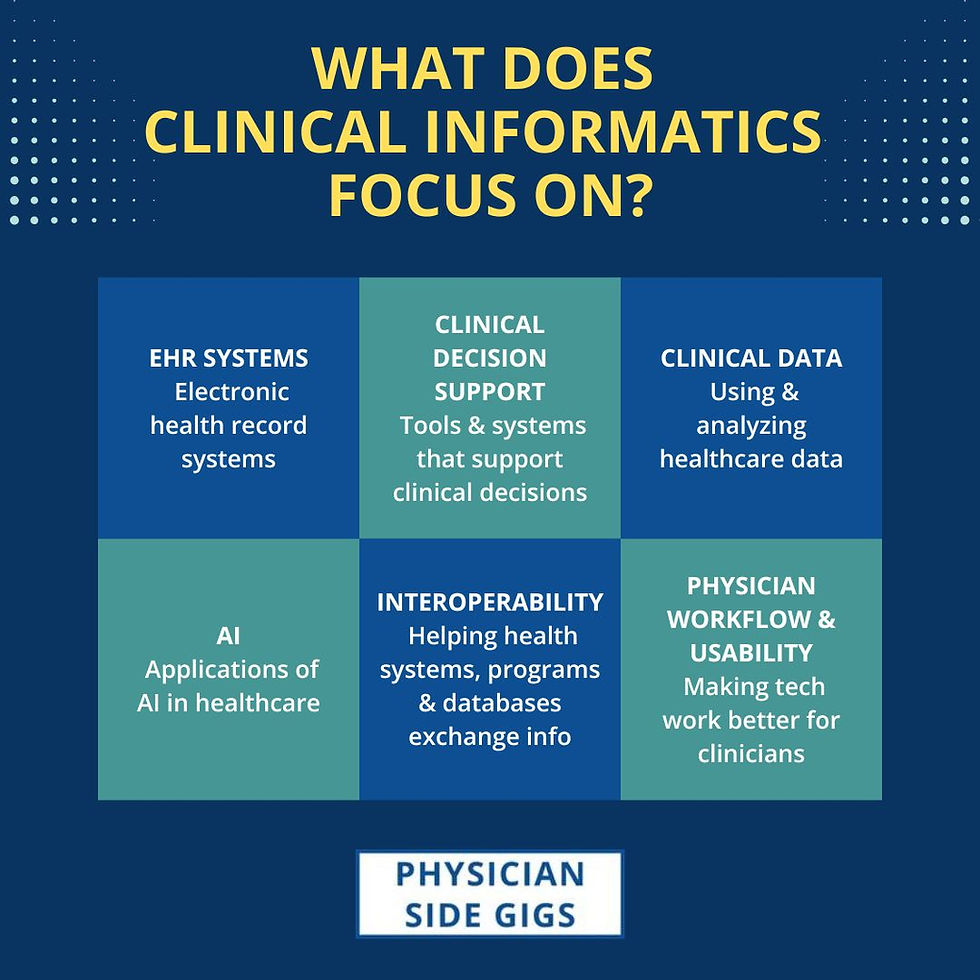
To make things more tangible, here are some things clinical informatics may focus on:
Electronic Health Record (EHR) Systems
Clinical decision support
Clinical data
The use of AI
Intraoperability that allows different health systems, programs, and databases to exchange information
Physician workflow and usability
What is a physician informaticist?
In the United States, clinical informatics is now an officially recognized physician subspecialty with a 24-month ACGME-accredited Clinical Informatics fellowship and an ABMS-recognized board certification pathway, designed specifically for physicians who want to apply informatics to clinical care.
The best way to summarize what they do is to say that clinical informaticists sit at the intersection of clinical medicine, technology, data, and healthcare operations. They’re not necessarily programmers or coders (though they can be). Their role is really to ensure that the technology does what it’s intended to do when it’s actually deployed within a workflow or patient care, because they understand both sides of the technology - the design and the real life use cases.
What are some examples of what a physician clinical informaticist does?
Physician informaticists are uniquely trained as physicians, but also in technology. They then use that combination of skills to improve healthcare processes and practice by serving as a bridge between clinicians and technologists within a system or company. Because they understand the clinical workflows and implications of the technology that they are deploying, as well as how the technology works, they are uniquely positioned to help design technology, plan integrations, give feedback to engineers, educate clinicians, and otherwise help navigate the divide between what looks great from a technical perspective and what actually works in the clinical world.
Things that they might focus on include:
Iterating Electronic Health Record (EHR) Systems design to make it more efficient, streamlined, or optimized for clinicians
Developing (and evaluating) clinical decision support tools and alerts
Clinical data and analysis of that data to support quality improvement or other objectives
The use of AI within clinical workflows and systems to improve efficiency and effectiveness
Ensuring best practices are followed with regards to governance, patient privacy, and compliance measures
Collaborating with teams of engineers
Gathering feedback from colleagues and relaying them to the technical teams
What career paths exist for physicians within clinical informatics?
We’ve seen physicians use these skills in a lot of different ways. Traditionally, most early clinical informatics physicians took roles within their hospital systems where they served in the roles described above. These includes roles such as:
Physician Informaticist: Tasks include optimizing EHR workflows, clinical documentation, order sets, alerts, and decision support
Medical Director of Clinical Informatics: Tasks include leading informatics strategy for a hospital, medical group, or health system
CMIO (Chief Medical Information Officer): Tasks include executive leadership over clinical IT, EHR strategy, digital transformation, and physician adoption
Associate/Assistant CMIO
EHR/Clinical Systems Medical Director: Tasks include leading implementation and optimization of large electronic medical systems
Clinical Decision Support Physician: Tasks include developing evidence-based alerts, order sets, guidelines, and decision-support tools
Interoperability/FHIR physician leader: Tasks include working on exchange of clinical information between systems
Clinical Quality & Safety Informatics Officer: Tasks include using EHR/data systems to improve safety, quality, and outcomes
However, we’ve seen many of these physicians in our online physician communities move onto other roles, including:
Startup founder
Chief medical officer for an AI or health tech company
Medical Director working for a digital-health or healthcare technology company
Healthcare Data/Analytics Physician using clinical data for quality, population health, outcomes, and predictive modeling

Are most clinical informatics physicians in full time roles?
It really depends on the particular role and the scope of responsibilities. Some clinical informatics physicians are mostly clinical with a handful of informatics related responsibilities, whereas others have true hybrid roles where they have time to develop out defined roles and professional time. At the extreme are dedicated nonclinical executive roles.
Conclusion
Especially as healthcare systems rush to deploy new technologies and AI within their institutions and workflows to address the many challenges in modern day care delivery, the role of a physician who understands both the tech side and the patient care side is becoming increasingly important. If you enjoy thinking about things from both perspectives, it may be worth exploring the field more carefully. While there is now a formal pathway for fellowship/board certification, many physicians perform this type of work for their hospital systems. If you want to get more entrenched in the space or hold an executive role related to clinical informatics, it may make sense to explore getting the certification as well!
Additional career resources for physicians
Sign up for our weekly newsletter for alerts about locums opportunities, upcoming related free webinars, additional educational resources, and more.
Related PSG resources: