


How Physicians Are Using AI Tools Like Claude and ChatGPT in Practice Marketing
Ask a physician on our physician communities what they think of AI in marketing, and you typically get one of two reactions. One is enthusiasm: “It can write a blog in seconds.” The other is skepticism: “It produces generic content that sounds like every other medical website.” Both observations can be true. The fact is that AI is going to impact the way we do most things, and your private practice’s marketing is no exception. Below, we’ll cover what to know about using AI for practice marketing, pros and cons, and how to think ahead about strategic incorporation of this new tool.
This article was in part contributed by our partners at GMR Web Team, a healthcare-exclusive growth advisory and digital strategy firm that designs and executes integrated growth systems to increase profitability, strengthen brand authority, enhance patient experience, and build long-term enterprise value. Read more about them below.
Disclosure/Disclaimer: This page contains information about our sponsors and/or affiliate links, which support us monetarily at no cost to you. These should be viewed as introductions rather than formal recommendations. Our content is for generalized educational purposes. While we try to ensure it is accurate and updated, we cannot guarantee it. Rules/laws can change frequently. We are not formal financial, legal, or tax professionals and do not provide individualized advice specific to your situation. You should consult these as appropriate and/or do your own due diligence before making decisions based on this page. To learn more, visit our disclaimers and disclosures.

Article Navigation
An overview of current day AI marketing uses, and key distinctions between using AI and outsourcing marketing
Tools such as ChatGPT and Claude have become increasingly capable at working with text, documents, research, ideas, and structured information. For a private practice, that creates opportunities to reduce the time spent on repetitive marketing tasks, and opportunities to build out content that build both SEO and GEO. If you are still getting familiar with how AI is changing the way patients discover healthcare providers, What Is GEO and Why Does Your Private Practice Need to Care?, provides that broader context.
But an important distinction exists between using AI to do marketing work and letting AI determine your marketing strategy. A physician can ask ChatGPT to brainstorm topics for a dermatology practice. Claude can help organize a long document into a content outline. An AI tool can turn a physician's existing educational material into social media posts. These are all wonderful uses time and money saving tools when it comes to marketing.
However, none of those tasks answer a more important question: What should this practice actually be saying, to whom, and why? That distinction is the key to using AI effectively in practice marketing.
Where AI can genuinely help a private practice with marketing
The most useful AI applications aren't necessarily the most impressive. They are often the tasks that consume time without requiring a human to reinvent the wheel every time.
Brainstorming content ideas (and how to do it most effectively)
A physician may know the questions patients ask every day but not have time to turn those questions into a content plan. AI can help organize those questions into potential blog topics, FAQ pages, social media posts, video topics, email newsletter themes, patient education resources, and service page ideas.
If you want to do this in the most impactful way, it’s critical to learn how to ask the right questions to the AI agent. For example, instead of asking: "Give me 20 dermatology blog topics,” a more useful prompt might be: "I run a dermatology practice that focuses on adult acne. Based on these 15 questions our patients frequently ask, group them into content themes and identify which questions should be answered on service pages versus educational articles." The second prompt gives the AI useful context and a defined task. The physician or marketing team still needs to decide which ideas are strategically worthwhile.
Turning existing expertise into content
One of AI's strongest uses is helping practices repurpose existing information. Suppose a physician has a presentation, a patient education handout, a webinar, an interview, a long FAQ, a recorded discussion, or notes from a talk. AI can help turn that material into an outline, summary, social post, email, and/or first draft.
This is different from asking AI to invent expertise from scratch. The practice or physician is supplying the underlying knowledge. AI is helping organize and transform it. That distinction matters because Google itself recommends creating unique, valuable, people-first content and warns against producing large quantities of generic content primarily to manipulate search or generative AI results. The best source material for healthcare marketing is often the expertise already inside the practice.
Creating first drafts and giving you a launchpad to start from
AI can also reduce the friction of getting started (which we all know is often the hardest part). A physician may know exactly what they want to communicate but struggle to turn the idea into a polished first draft. AI can help produce an initial version of a patient newsletter, a social media caption, a video script, a practice announcement, a physician biography, an FAQ, an email, or a blog outline.
The important word is first. A first draft is not a finished marketing asset. Healthcare content needs review for accuracy, context, tone, medical appropriateness, and consistency with the practice's actual services. Use the AI suggested content to build upon and add further value to.
Repurposing content across channels
A single piece of useful content can often serve several purposes. For example, a physician publishes an article explaining the signs of sleep apnea. AI can help transform that article into a short social post, a patient newsletter, a video script, a list of frequently asked questions, and discussion points for a physician interview.
The benefit is not that AI suddenly creates a comprehensive marketing strategy. The benefit is that it can reduce the manual work involved in adapting an existing idea to different formats. That can be particularly useful for small practices with limited marketing resources or time.
Organizing and analyzing marketing information
AI can also be useful when the challenge is not creating information but making sense of information that already exists. A practice could use an appropriate AI environment to help organize content inventories, website page lists, patient FAQ themes, review themes, campaign ideas, editorial calendars, competitor observations, marketing reports, and survey responses.
For example, instead of manually sorting dozens of patient questions, a marketing team could ask an AI tool to group them into themes such as symptoms, treatment questions, preparation, recovery, cost and insurance, and when to seek care. The AI has helped with organization. The team still determines what the categories mean and what action should follow.
Improving the quality of prompts and workflows
Interestingly, AI can also help people become better at using AI. If a physician says: "Write a blog about diabetes." The result will probably be broad. But the physician could ask the AI to help create a better prompt: "Help me develop a prompt for an educational article aimed at adults newly diagnosed with Type 2 diabetes. The article should explain questions patients commonly have before their first follow-up appointment and should avoid giving individualized medical advice."
The resulting workflow is more controlled. This is an important lesson: Better instructions generally produce more useful outputs. But even an excellent prompt does not eliminate the need for review.
Where exclusive use of AI starts to fall short in marketing
The limitations become clearer when a practice expects AI to do more than accelerate defined tasks.
AI does not know your practice the way you do
A general AI model does not automatically understand your patient population, your local market, your referral relationships, your physician's clinical strengths, your practice capacity, which procedures you want to grow, which services have the best strategic fit, which patients you are trying to reach, or what differentiates your patient experience. You can provide context, but the practice still has to determine what matters, and it’s still got to resonate with your patients.
This is one reason generic AI-generated marketing can sound polished while saying very little. "Compassionate care." "Personalized treatment." "Comprehensive services." "Patient-centered approach." These phrases may be grammatically correct. They are not necessarily meaningful differentiators.
AI can produce confidently wrong information
Generative AI systems can produce inaccurate statements, incomplete explanations, or unsupported claims. That is especially important in healthcare. A sentence can sound authoritative and still require verification.
The solution is not simply to tell the AI: "Do not hallucinate." The solution is to build a review process around the output. For healthcare marketing, that may mean checking medical claims, statistics, guidelines, drug information, treatment descriptions, credentials, practice information, legal or regulatory claims, citations, and dates.
Google's guidance for generative AI search also emphasizes reliable, people-first content and specifically advises that AI-assisted content still needs to meet its Search Essentials and spam policies. AI can accelerate the drafting process. It does not remove the fact-checking process.
AI can make every practice sound the same
This may be one of the biggest marketing problems. If 500 practices ask AI: "Write a professional homepage for my medical practice." they may receive 500 versions of essentially the same language. That creates a paradox. AI can make content production easier while simultaneously making differentiation harder.
The way around this is to give AI something genuinely distinctive to work with. That might include physician interviews, patient questions, original observations, practice philosophy, local knowledge, clinical experience, unique processes, real examples, physician commentary, and original data. Google's current guidance makes a similar point, emphasizing unique, non-commodity content and firsthand expertise rather than recycling information an AI model could easily produce. AI should help express your expertise, not manufacture a substitute for it.
AI does not know which marketing problem matters most
Imagine a practice has declining new patient volume. An AI tool might generate 50 ideas: write more blogs, post more on social media, improve SEO, run ads, update the website, create videos, ask for more reviews, and launch email marketing. All of those might be reasonable tactics.
But what if the actual problem is that the practice has limited appointment availability? Or the website attracts plenty of visitors but does not convert them? Or the practice is ranking well for general terms but not for the services it wants to grow? Or patients find the practice but choose competitors after reading reviews?
AI can help answer these questions when given the right information. But deciding which problem deserves attention first is a strategic decision. That requires context.
AI does not replace human review
Healthcare marketing has several layers of review that generic content marketing may not require. A piece of content may need to be evaluated for clinical accuracy (Is the medical information correct and appropriately qualified?), patient safety (Could the wording cause someone to misunderstand when they should seek care?), brand accuracy (Does it accurately represent what the practice offers?), compliance (Does the content meet applicable legal, privacy, advertising, and organizational requirements?), search quality (Is the content genuinely useful rather than simply written to target a keyword?), and patient experience (Would a real patient find it understandable and helpful?).
AI can assist with parts of these processes. It should not be treated as the final authority.
What about patient privacy?
This is where physicians need to be especially careful. Marketing teams sometimes work with information that may contain names, contact details, appointment information, medical details, or other sensitive data. Don't paste that information into a consumer AI tool just because it is convenient. The appropriate approach depends on the specific product, account type, configuration, organizational policies, and applicable legal requirements.
For example, OpenAI states that business offerings such as ChatGPT Business, Enterprise, and ChatGPT for Healthcare do not use customer content to train models by default, and certain healthcare products can be used under a Business Associate Agreement. Anthropic similarly states that inputs and outputs from its commercial products are not used to train its models by default.
Those statements do not mean that any AI account is automatically appropriate for handling protected health information. The practice still needs to determine what information is being entered, which product is being used, whether the account is an approved business environment, whether appropriate agreements are in place, what organizational policies apply, and whether the specific workflow is authorized. For healthcare organizations, OpenAI specifically distinguishes between general ChatGPT use and HIPAA-eligible products and configurations.
A simple rule is useful: If you are unsure whether information can be entered into an AI tool, do not enter it until your privacy, compliance, or IT requirements have been checked.
ChatGPT vs. Claude: what should a practice use?
No universal reason exists for every practice to choose one AI tool over another. Both ChatGPT and Claude can assist with common marketing tasks such as drafting, brainstorming, summarizing, organizing information, and transforming existing material. The more useful question is: Which tool and workflow fit the task, information, privacy requirements, and people responsible for the work?
A practice might use one tool for drafting and another for a particular analysis workflow. Or it may standardize on one environment to make training, permissions, review, and governance easier. The important thing is not to treat the AI tool itself as the strategy. The workflow around the tool matters more than the tool's novelty.
A better way to use AI in practice marketing
Instead of: Idea → AI → Publish. Build a process like this:
Start with the practice. Define the audience, objective, service, message, and relevant clinical context.
Give AI the right source material. Provide approved information, physician notes, existing content, research, FAQs, or other materials that the AI is permitted to process.
Ask AI to assist. Use it to brainstorm, organize, draft, summarize, repurpose, or analyze.
Verify. Check facts, sources, medical information, statistics, credentials, and claims.
Add human judgment. Ask: Does this actually sound like our practice? Does this address a real patient need? Is this strategically useful? Does it differentiate us?
Review and approve. The appropriate physician, subject matter expert, marketer, or organizational reviewer should approve the final material.
Measure the result. Look at what happened after publication. Did people engage? Did traffic change? Did calls or appointment requests change? Did patients ask better-informed questions? Did the content support a broader marketing objective?
The process turns AI from an autonomous content generator into a workflow accelerator.
What AI is good at, and what humans still need to own
A useful division looks like the below graphic.
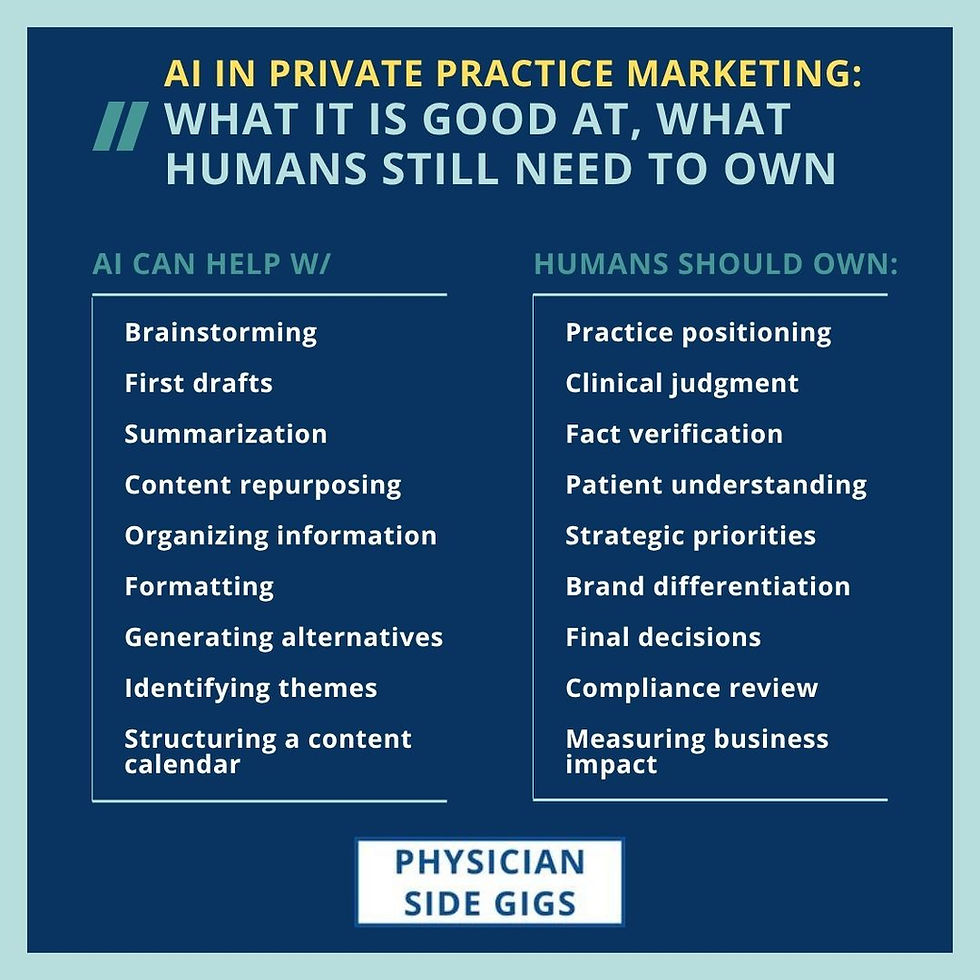
This distinction matters because AI tempts us to automate the entire process. But automation is only useful when the underlying process is sound. Automating a bad marketing strategy simply allows a practice to execute the wrong strategy faster.
The biggest lesson: do not start with the tool
A practice should not begin with: "We have ChatGPT. What can we make it do?" Start with: "What are we trying to accomplish?"
If the goal is to answer common patient questions, AI may help develop and organize content. If the goal is to improve a website, AI may help identify gaps, draft page structures, or review existing copy. If the goal is to understand patient feedback, AI may help categorize large volumes of qualitative information. If the goal is to increase appointments, however, AI alone cannot tell you which part of the acquisition and conversion process is actually limiting growth.
The tool comes after you define the problem. That is perhaps the most important lesson for physicians experimenting with AI in marketing.
The AI sweet spot for private practices
The most practical use of AI may sit somewhere between two extremes. On one side: Do everything manually. On the other: Let AI run the marketing. Neither approach is necessary.
The more useful middle ground is: Human strategy → AI assistance → Human review → Measurement. That allows physicians and practice teams to gain efficiency without surrendering judgment. It also makes AI more valuable. Instead of asking an AI system to replace the expertise inside your practice, you are using it to make that expertise easier to organize, communicate, and distribute.
Conclusion
ChatGPT and Claude can do a remarkable amount of work. They can help turn a blank page into a draft, a long document into an outline, a physician interview into multiple content formats, and a collection of patient questions into organized themes. Those are real productivity gains.
But the limitations matter just as much. AI does not automatically understand your market. It does not know your practice's priorities. It cannot independently determine which patients you should be trying to reach. It can make factual mistakes. It can produce generic language. And you should not trust it with sensitive healthcare information simply because a particular tool makes it easy to upload.
The practices that get the most value from AI are therefore unlikely to be those that simply produce the most content. They will be the practices that understand where AI can accelerate work and where human expertise must remain in control. The central question is not: "Can AI do this?" It is: "Should AI do this, and what level of human oversight does this task require?"
That question matters even more when deciding who should manage a practice's marketing. Some physicians can handle foundational work internally. Others may benefit from AI-assisted workflows. More complex practices may need specialized marketing expertise alongside internal clinical knowledge. That is the subject of the final article in this series: DIY, AI, or Experts? Choosing the Right Marketing Approach for Your Practice.
Related resources for physicians
Sign up for our weekly newsletter for alerts about side gig opportunities, upcoming related free webinars, additional educational resources, and more.
Putting AI and a modern digital strategy into practice can become increasingly complex as a practice grows.
GMR Web Team is a healthcare-exclusive growth advisory and digital strategy firm that designs and executes integrated growth systems to increase profitability, strengthen brand authority, enhance patient experience, and build long-term enterprise value. Its framework brings together strategic positioning, market visibility, reputation intelligence through RepuGen, AI-driven patient engagement, and performance analytics across different stages of practice growth.
As a PSG partner, GMR Web Team offers members 20% off website hosting and development, plus free monthly patient newsletters and automated patient birthday and holiday e-cards for up to 1,000 communications per month. Explore the PSG member benefits here.
Related PSG resources: