


Should I Use AI to Make My Website? Where AI Helps & Where It Falls Short
Your website is a critical part of your business, and often one of the first steps physicians take when establishing their private practices or side gigs. As such, we often get posts in our online physician communities asking for recommendations for website builders or developers to help create a website. Lately, we’ve seen a lot of responses saying: "Just have Claude build your website." Or ChatGPT. Or whichever AI tool is making headlines this week. It's not bad advice, but it's incomplete. AI has fundamentally changed how websites are built and maintained, and for many tasks, it's remarkably effective. Even professional website designers use AI everyday to help work faster and more efficiently. But it’s important to know where it adds value and where it falls short, and where human expertise still makes a difference. Below, we’ll cover what AI can genuinely do for your website, where its limitations begin, and how to decide when a DIY approach makes sense versus when professional guidance is worth the investment.
The information for this article is original material contributed by our partners at Artillery, who are professional website designers. They have helped numerous physicians in our community. Mention PSG for an exclusive $200 off a website custom designed for your private practice when you reach out at artillerymedia.com.
Disclosure/Disclaimer: The team at Physician Side Gigs did not write this content and the views expressed here are written by and that of the team at Artillery Media - the decision to contact Artillery Media for more information about website design is your own, and mention of Artillery Media should be viewed as an introduction rather than a recommendation. We do not make specific investment recommendations or endorsements, and are not qualified to do so, as we are not formal financial, legal, or otherwise licensed investment professionals. You should consult these as appropriate before making any decisions based on what you read here. Please do your own due diligence before making decisions based on this website. The use of this website constitutes understanding of these terms. To learn more, visit our disclaimers and disclosures.
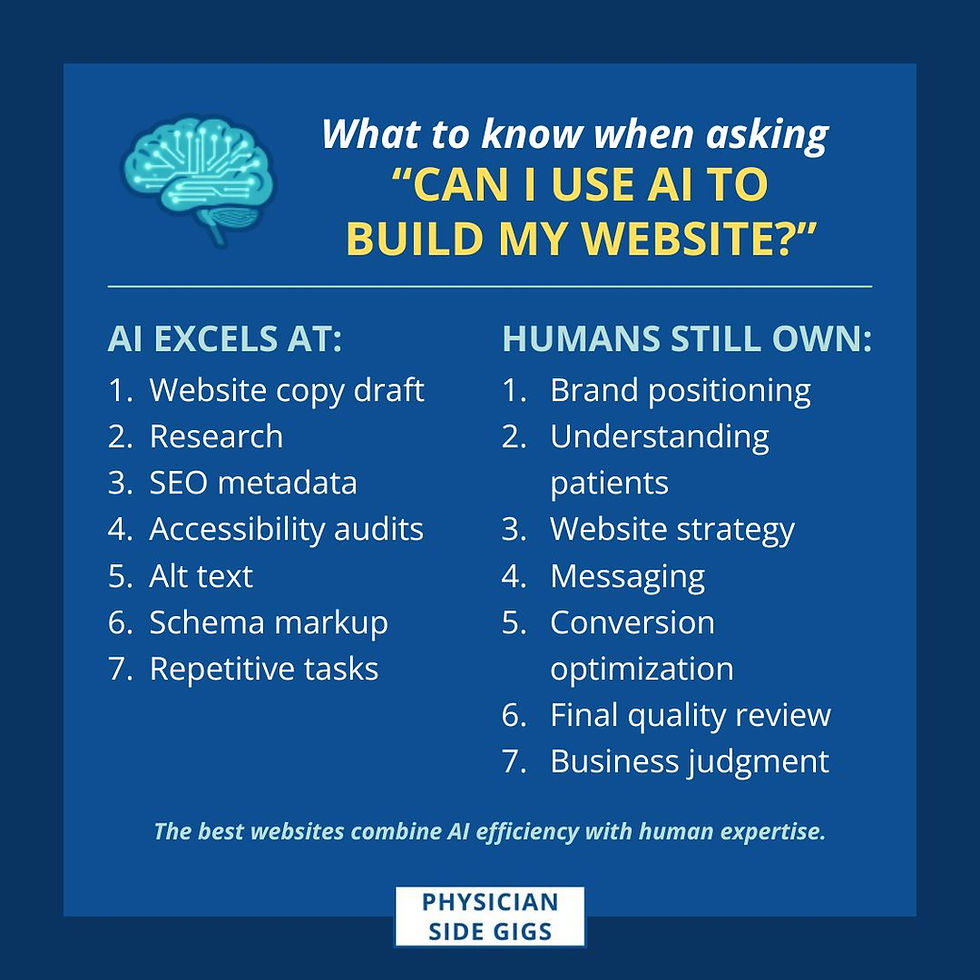
What AI can do well when using it to create your website
Let's give credit where it's due. AI tools have gotten remarkably good at certain types of website work. Specifically, the structured, repeatable, bounded stuff that used to eat hours.
Content drafts
This is the most common use case, and for good reason. Getting words out of a busy professional is the hardest part of any website project. AI turns a blank page into a first draft you can actually edit. That's genuinely valuable.
For context: content has always been the single biggest bottleneck in any website project. The design and development move fast once the words are in place. AI cut that timeline dramatically, because editing a draft is always faster than starting from a blank page.
Research and data gathering
Need to pull competitor info? Summarize a 30-page report? Organize a messy spreadsheet of services into a clean list? AI handles this well. According to a recent SiteGround survey of over 7,000 WordPress users, research (66%) and writing (65%) are the top two uses by a wide margin.
Repetitive technical tasks
This is where AI shines brightest, and it's the part most people don't talk about. The death-by-a-thousand-clicks work that nobody wants to do:
Image alt text. Every image on your website needs a text description so screen readers can announce it to visitors who can't see the image. On a site with 200 images, writing those by hand takes hours. AI can draft them in minutes. It can actually "see" the image and describe what's in it.
Schema markup. This is the invisible code that tells Google and AI search tools exactly what your business is, where you're located, what services you offer, and how trustworthy you are. Setting it up manually across every page of a site is tedious, detail-heavy work. AI handles the generation; a human verifies it passes Google's validation tools.
Metadata cleanup. Page titles, meta descriptions, header tags. The behind-the-scenes content that search engines read. AI can audit an entire site and draft improvements in a fraction of the time it takes to do manually.
Accessibility audits. Checking heading structure, color contrast ratios, form labels, and keyboard navigation across every page. AI catches the mechanical violations quickly. (If you read our previous article on ADA compliance for websites, you know how much goes into this.)
These aren't hypothetical. At Artillery, we manage over 500 WordPress sites. We built tools that let AI connect directly to a client's site, audit the content, draft fixes, and push updates. All supervised by a human who reviews every change before it goes live.
The key phrase there is supervised by a human.
Related PSG resource: Artillery is a long time sponsor of our physician communities and designs attractive websites at a reasonable price. They have helped numerous physicians in our community. Mention PSG for an exclusive $200 off a website custom designed for your private practice or side gig business.
Where AI falls apart when using it to create your website
Here's the part that doesn't show up in the community threads.
It doesn't know your business
AI has no idea who your patients are, what makes your practice different, why someone should choose you over the group down the street, or what your homepage should promise in the first five seconds.
It can generate a homepage. It'll look like a homepage. It might even sound reasonable. But it's writing from patterns. What a medical practice homepage "usually" says. That's generic, and generic doesn't convert visitors into patients as effectively, because it doesn't make them attached to your brand and mission. If somebody else has availability sooner or offers a service for cheaper, they'll go there instead.
Your website's job isn't to exist. It's to answer three questions in about two seconds: Who is this for? What do they get? What do I do next? AI doesn't know your answers to those questions. You do.
It requires multiple tries
That same SiteGround survey found that while 72% of business owners say AI saves them time, 41% say getting a usable result takes multiple tries, and 22% don't trust its accuracy.
Read those together. A lot of the people saying "AI saves me time" are spending that saved time checking the AI, re-prompting the AI, and fixing the AI. The tool is fast, but somebody still needs to know whether the output is any good.
It can break things you don't know about
WordPress runs about 43% of every website on the internet. It's powerful, but it's also complex. The dashboard looks like a cockpit full of knobs if you haven't spent time learning what each one does.
AI can generate code, suggest plugin configurations, and even make live edits to a site. But if you don't know what "right" looks like, you won't catch what "wrong" looks like either. We've seen AI-generated code that looked perfectly reasonable but broke a site's contact form, messed up its mobile layout, or introduced a security vulnerability.
96% of WordPress security problems come from plugins. There are now over 3,500 AI plugins in the WordPress directory. More tools does not equal more results. It usually just builds what we call a plugin monster.
Strategy is still a human job
What should your site say? Who is it for? How should it be structured so a real person can find what they need? What's the one thing your homepage should promise?
AI doesn't do strategy. It doesn't understand your competitive landscape, your patient demographics, your referral patterns, or why the practice three miles away keeps showing up above you in search results.
SiteGround's own report puts it plainly: "Creative strategy, brand decisions, and novel technical architecture still require human judgment." We agree.
The real question: who confirms the output is as good as it needs to be to get the results that you want?
This is the core of it. Every AI tool (Claude, ChatGPT, Gemini, all of them) produces output that looks confident. It reads well. It's grammatically correct. It sounds professional.
But "sounds professional" and "is correct for your specific situation" are two different things.
When we use AI to draft alt text for a physician's website, a human looks at every image and confirms the description is accurate, specific, and useful to someone using a screen reader. AI might label a photo "doctor in office," but the useful description is "Dr. Patel reviewing a chart with a patient in the clinic."
When we use AI to generate schema markup, a human runs it through Google's Rich Results Test and verifies that every data point (business name, address, services, ratings, credentials) is accurate. One wrong detail in your schema can confuse every search engine and AI tool that reads your site.
When we use AI to draft website copy, a human reads it. Then the client reads it. Two humans in the loop. The AI saved us time. Somebody still confirmed the output was good.
That's the real job: confirming the output, not just generating it.
The question isn't whether AI can produce something. It almost always can. The question is whether you have the expertise to evaluate what it produced, catch what it got wrong, and know what "good" looks like for your specific situation.
If the answer is yes, great. AI just made you faster.
If the answer is "I'm not sure," that's the moment to find a web team that uses AI well and can be that quality check for you.
Related PSG resource: Artillery is a long time sponsor of our physician communities and designs attractive websites at a reasonable price. They have helped numerous physicians in our community. Mention PSG for an exclusive $200 off a website custom designed for your private practice or side gig business.
What a good web team actually uses AI for
A web team worth hiring in 2026 should be using AI. The question is how.
Here's what it looks like in practice. When a firm onboards a new client site, one of the early steps is an accessibility pass: making sure every image has proper alt text, every page has correct heading structure, and the site meets current accessibility standards.
On a 40-page site with 200 images, that used to take a full day or more. AI handles the initial audit and drafts the fixes in a fraction of the time. But a human still reviews every recommendation, because AI doesn't know that the photo it described as "group of people in a conference room" is actually your founding partners at their first office. Context matters.
Same with content. AI drafts, humans shape it, and the client approves it. The AI is the power drill. The human is the carpenter who knows where the studs are.
What AI shouldn't be doing: deciding what your website says, choosing your brand positioning, structuring your site architecture, or making judgment calls about what matters to your patients. If a web team can't tell you where AI stops and human judgment starts in their process, that's worth asking about.
Should you have Claude build your website, and how can you use it to help you regardless?
Let's answer the question directly: it depends on where you are.
There are real tools out there now. Platforms like Base44, Lovable, and even Claude itself can generate a working website from a conversation. If you're just getting your business off the ground and need something up fast while you figure out your positioning, that might be a perfectly fine use of your time. A basic site that exists is better than a perfect site that doesn't.
But if you're an established practice with patients, referral networks, and a reputation to protect, the calculus changes. You shouldn't be spending your evenings learning about A records, DNS settings, which code language goes where, or why your contact form stopped working after an update. That's not a good use of a physician's time, and the cost of getting it wrong on a live business site is real: lost patients, compliance risk, poor search visibility, and hours spent fixing something that should have been built right from the start.
The sweet spot for most established businesses isn't DIY and it isn't old-school either. It's finding a web team that actually uses AI in their process, is honest about how they use it, and can tell you exactly where the human judgment lives in the work. The best version of this is a professional who got faster and more thorough because of AI, and who passes some of that efficiency on to you.
Where AI fits for you personally: Use it to draft content (then have someone review it). Use it to research competitors. Use it to organize your thoughts before a meeting with your web team. Use it to check your site's accessibility. Those are all great applications, regardless of who builds the site.
Five things to know before deciding to use AI to make or improve your website
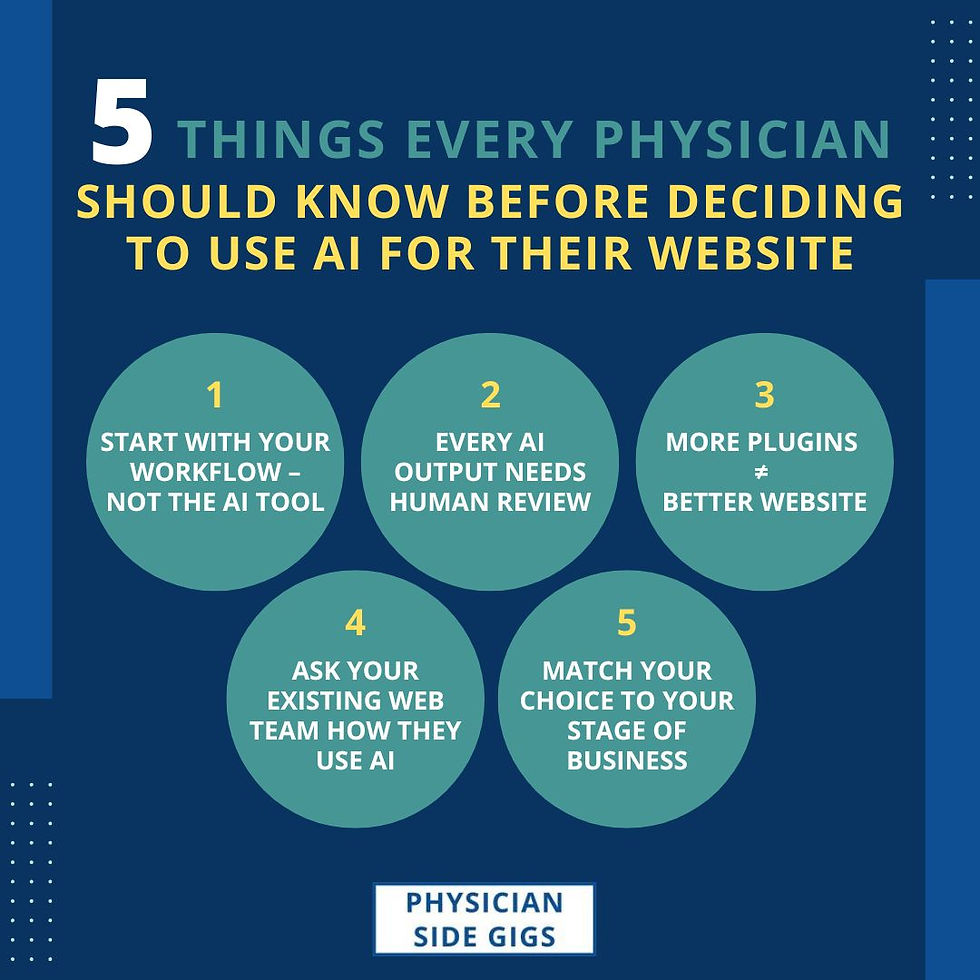
1. Start with the workflow, not the tool
Before you install a single AI plugin or open a single chat window, look at where your website time actually goes. What's eating your hours? What's not getting done? Start there.
2. Somebody has to check the work
Every AI output needs a human review. Content, code, metadata, images. If it's going on your live site where patients see it, a person needs to confirm it's accurate and appropriate.
3. More plugins is not more results
Every WordPress plugin is another thing that can break and another potential security vulnerability. Don't go to the plugin directory, search "AI," and install whatever looks interesting. Be intentional.
4. Ask your web team how they use AI
If you already work with a web team, ask them. A good one will tell you exactly where AI fits in their process and where it doesn't. If they can't answer that question clearly, or if they're not using it at all, it's worth shopping around. A web team that uses AI well can do in weeks what used to take months, and they should be transparent about how.
5. Match the tool to where you are
Just getting started? A DIY AI tool might be a great way to get something up while you find your footing. Already established with patients and a reputation? Your time is better spent on your practice, and your website deserves someone whose full-time job is getting this right.
Conclusion
AI has genuinely changed how websites get built and maintained. The tools are real, the time savings are real, and the capabilities are growing every month.
But the conversation in most online discussions has skipped a step. It went straight from "AI can help with this" to "you don't need to hire anyone anymore." The better version of that sentence is likely: "AI made the right people faster, and you should find one who uses it well."
Whether you're building your first site with a DIY tool or you're an established practice looking for a web team that keeps up with the times, the through-line is the same: somebody has to confirm the output is good. That's the part AI can't do for you yet.
The message from Artillery: Use the tool. Don’t hand it the keys.
If you're ready to turn a website that's more headache than asset into something that actually works for your practice, Artillery can help. Mention PSG at artillerymedia.com for an exclusive $200 off a custom-designed website for your private practice or side gig business.
Additional marketing related resources for physicians
Sign up for our weekly newsletter for new blog articles, physician educational webinars, and member resources.
Related PSG resources: