


Checklist for Starting a Podcast
Updated: Mar 24
Over half of US adults now report listening to podcasts, and as such, an entire industry has risen up around them. Increasingly, we are seeing that podcasts are a popular side gig option for members of our online physician community, whether they are primarily the side gig or used to augment a brand or business. A podcast offers the ability to build thought leadership, showcase partners or topics related to your business or brand, and build your own brand. With the right strategy and prep work, physicians can launch a podcast that fits into their demanding schedules and delivers real value to their listeners, while also providing an opportunity for an additional income stream through podcast sponsorships. Below, we cover what to consider when starting a podcast, using our own experience from starting the official Physician Side Gigs podcast, Inside the Doctor’s Lounge, and from insights we gained in our initial research and from our production team at Executive Podcast Solutions.
Disclosure/Disclaimer: This page contains information about our sponsors and/or affiliate links, including Amazon affiliate links, which support us monetarily at no cost to you, and often provide you with perks, so we hope it's win-win. These should be viewed as introductions rather than formal recommendations. As an Amazon Associate I earn from qualifying purchases. Our content is for generalized educational purposes. While we try to ensure it is accurate and updated, we cannot guarantee it. We are not formal financial, legal, or tax professionals and do not provide individualized advice specific to your situation. You should consult these as appropriate and/or do your own due diligence before making decisions based on this page. To learn more, visit our disclaimers and disclosures.
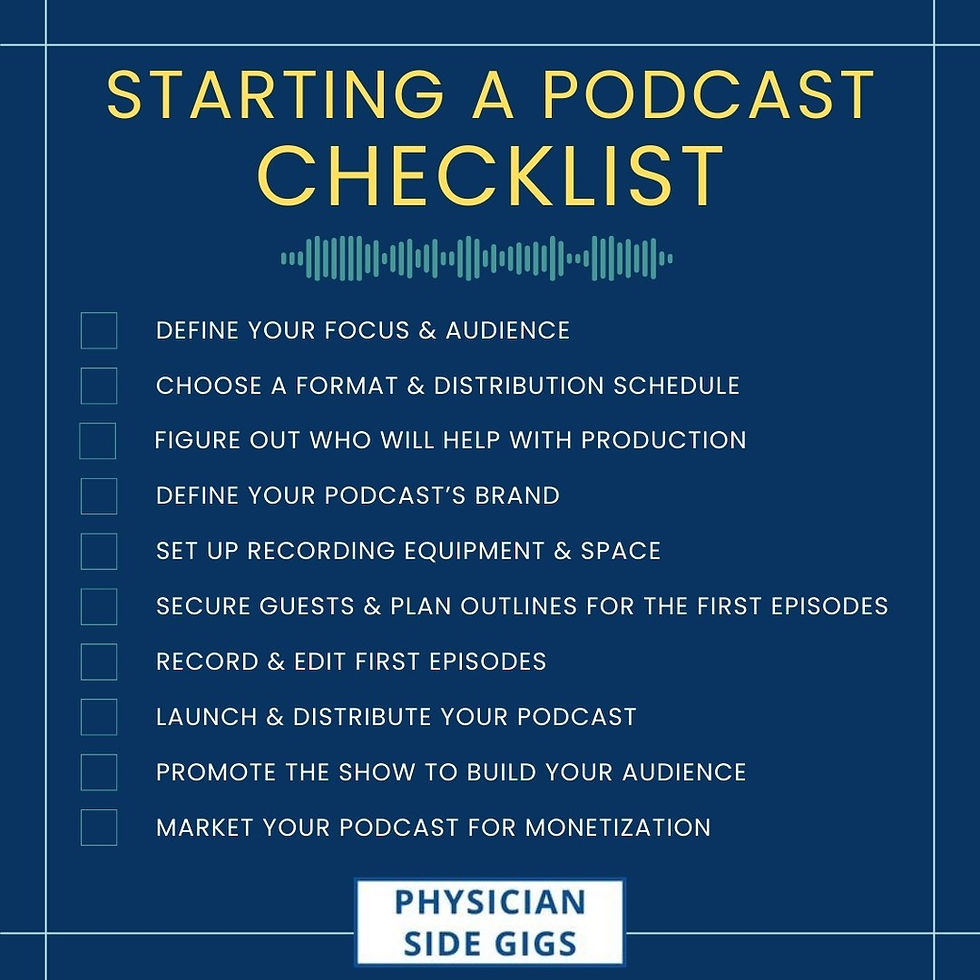
Checklist for starting a podcast
Define your podcast’s focus and target audience
Before you dive into buying equipment and recording episodes, start with a clear picture of why you’re starting a podcast and who your podcast is for. And yes, the ultimate goal may be to create an additional income stream through this side gig, but your “why” should be much more focused than that. Ask yourself:
What problem can you help solve with this podcast?
What topic and conversations are you uniquely qualified to discuss?
How will this podcast support your overall goals?
This can help you get a better understanding of where to start. As an online physician community, for example, we wanted the PSG podcast to focus on important topics that happen daily within our community and to expand upon them in a longer format to provide much deeper insights than those possible in comments, posts, or articles.
Along with the topic or focus of your podcast, you’ll want to make sure there’s an audience out there that aligns with your topic, whether it’s medically related to not. Knowing who that target audience is will help you at every level, from deciding what to talk about, where to advertise your podcast, and what sponsors to bring on.
Choose a podcast format and pull together a run of show template
Once you know your “why” and your “who”, focus on the “how” of formatting. The best format for your podcast is the one you can realistically maintain.
Common podcast styles include:
Solo episodes: Educational talks or commentary
Co-hosted podcast: Dialogue between hosts
Interview style: Conversations with other physicians, experts, etc.
You may also consider a hybrid style, where you provide solo commentary for part of the show and interact with guests for the other part.
Along with your podcast’s style, determine what episode length you’d like to aim for.
Around 30 minutes seems to be a sweet spot, so aiming for 20-40 minutes can be a good target that can be manageable for busy physicians versus an hour or longer episodes.
Longer form discussions can still be just as engaging, so long as the content is interesting.
You’ll also want to establish your distribution schedule of how often you want to publish episodes. Common release schedules are:
A few days a week on certain days
Once a week, on a specific day
Every other week, on a specific day
To help lower the time commitment requirement, you can also consider breaking your podcast up into seasons of a certain number of episodes and then pausing before releasing another batch of episodes.
As you prepare for your podcast, a final consideration is if you want to do audio only or audio and video, which can also help you cross promote and post your podcast on channels such as YouTube and provide video clips for marketing it on social media.
Figure out who’s going to help you produce your podcast
This is perhaps one of the hardest parts of the podcast journey. Podcasts are work. They’re a regular time commitment to finding guests, releasing content on a schedule, publicizing that you’re doing it - and that’s not even counting the technical aspect of things. That includes things like:
Scheduling guests
Editing the podcast episodes themselves once they’ve been recorded - editing out mistakes or clips you don’t want to use, correcting lighting, take out pauses, etc.
Pairing the podcast episode with other show assets (intro/outro, sponsors, etc.) to form the final releasable product
Preparing episode graphics
Splicing out clips for social media
Preparing video and audio in appropriate ways for different media
Posting the podcast to the major podcast platforms, YouTube, and wherever else you’re releasing it
At some point you have to decide if you want this to be a DIY project, or if you want to outsource this, or some hybrid of the two. There are various ranges of involvement you can hire out, and various levels of professionalism and polish you will accordingly get for your podcast. We are really busy over here, so we’ve chosen to hire out everything to our friends at Executive Podcast Solutions (not sponsors, we just really like working with them - tell them we sent you if you reach out!). That said, there are plenty of VAs you can hire on an hourly basis to help with whatever aspects you’d like to outsource, etc. Honestly, even an ambitious teenage child may be very good with editing videos and helping you upload to the various sites, and this could be a great way to fund your child’s Roth IRA.
Define your podcast’s brand
Before you start recording, finalize:
A podcast name
Tagline
Description
Logo/cover art
Theme music
You want something catchy and unique, that clues listeners into what they can expect but is unique so it’s easy to find.
Once you have a tentative name, check available social media handles and website domains. You’ll want to claim the same handle related to your podcast name across all social media platforms. This can include platforms where you aren’t planning on marketing, at least not at the beginning, just to own them so no one else takes them.
If you’re looking for help designing your logo and cover art, consider hiring a freelance designer through a site like Upwork (affiliate link). If you choose to work with a production team, they will likely be able to help here.
Get reliable recording equipment and set up a recording space
You don’t need expensive, professional level equipment to start, but you’ll need reliable tech including:
A USB microphone, such as a Blue Yeti for recording at home or the Audio-Technica ATR2100 USB for on-the-go mobility
A ring light to help with lighting for video, such as the NEEWER Ring Light Kit
A webcam like the Logitech C920x HD Pro Webcam if doing video
Recording software, such as Captivate, Descript, or SquadCast (a production team can help here as well)
You should also designate a clean and quiet place to record your podcast, which could be in your office after hours or in a study at home. This doesn’t have to be a dedicated space just for recording, like a studio, but should look professional if you’re doing video with your podcast and sound professional (such as no kids arguing in the background or family members watching TV) regardless of your format.
Reach out to guests and develop outlines for your podcast episodes
Batch recording can be an efficient way to get episodes prepped around a busy schedule. To prep for your first batch of episodes:
Pull together a guest wish list (if applicable) and begin to reach out to assess interest and coordinate availability
Brainstorm potential episode topics
Jot down the key talking points to cover in each episode
Create a templated outline for your podcast episode
Draft your intro and outro template to include in each episode
Once you have episode topics, you can leverage AI to help you brainstorm talking points. If you’re struggling to come up with episode topics, AI may be able to help there too.
Record and edit your first podcast episodes
As you prepare and record your first episodes:
Do a recording test “on set” to trial your setup and give yourself the opportunity to optimize your audio and video settings prior to scheduling your first episode recording.
Plan for partnerships. Leave spaces for future sponsors if you plan on having ads. Or start with conversations with friends if you plan on doing paid guest features in the future, etc.
Consider recording a short trailer episode first to tease the focus of your podcast. This can help get your podcast set up and verified in apps for people to find before you launch your first official episode.
We recommend having a certain number of episodes recorded “in the can” so you have a buffer. It can help to have 1-2 months of episodes prepped before launching your podcast to help cover scheduling issues when life unexpectedly happens.
A production team can help on the recording and editing side if you aren’t as tech savvy and don’t want to get into the weeds of preparation and distribution.
Launch and distribute your podcast
Your recording and editing software may have distribution integrated. If not, there are popular options podcasters use, such as Libsyn. As you plan and deploy, make sure to check off:
Selecting a podcast hosting platform
Submitting your podcast to major platforms (key players are YouTube, Apple & Spotify)
Write your episode titles and descriptions with SEO keywords to help get your podcast discovered
Upload the cover art
Related PSG resource:
Promote your podcast to raise awareness
As you launch your podcast, don’t forget to spread the word!
Announce it to colleagues and related professional/interest groups
Share clips and quotes on social media (LinkedIn, TikTok, Instagram, etc.)
Invite guests to be on the show who can help crosspromote their episode to build overall awareness
Create a website for your podcast where listeners can find out how to subscribe & listen to episodes
Related PSG resources:
Squarespace is a really easy way to create websites with stylish templates yourself. Mention code PARTNER10 for 10% off through our affiliate link.
Artillery designs and builds attractive websites optimized for SEO that are pretty reasonably priced (usually 2-5k depending on complexity). Mention PSG for $200 off.
GMR Web Team is a healthcare-exclusive growth advisory and digital strategy firm that designs and executes integrated growth systems to increase profitability, strengthen brand authority, and build long-term enterprise value. GMR’s proprietary framework aligns strategic positioning, market visibility, AI-driven patient engagement, and advanced performance analytics into a unified engine for predictable expansion. PSG members receive 20% off website hosting and development when they sign up through our affiliate link.
Put together a media kit to help market your podcast
As you look to monetize your podcasting side gig, consider creating a media kit including:
Information about your podcast (podcast name, description, etc.)
Headshot and bio of the host(s)
High profile or positive reviews from listeners
Demographics of your audience and subscriber counts
What sponsorship or advertising packages you have available
How to contact you to learn more
Conclusion
Starting a podcast can help physicians share their expertise beyond an exam room and help them reach a larger audience, all while building an additional revenue stream with potential passive income from ad revenue on published episodes. Podcasting can be a game of patience, as it can take time to find traction and build a following, but it’s a great way to let your physician voice be heard.
Related resources for physicians
Explore related PSG resources:
Listen to our PSG podcast, Inside the Doctor’s Lounge.
Sign up for our weekly newsletter for alerts on new podcasting articles & other member resources & perks.