


Common Models for Private Practice Partnership Tracks, and Pros and Cons of Each Pathway
For employed physicians in private practice, becoming a partner is likely the goal. However, private practice partnership can be complicated, with lots of different structures depending on the practice, as well as various pathways to getting partnership. As such, we often get questions on our online communities for doctors about different models for partnership tracks, what’s fair, and how much they should expect to pay for an ownership stake. Below, we’ll cover some common private practice partnership models, including pros and cons of each and how specialty, practice assets, and practice type may factor into available options.
Disclosure/Disclaimer: This page contains information about our sponsors and/or affiliate links, which support us monetarily at no cost to you, and often provide you with perks, so we hope it's win-win. These should be viewed as introductions rather than formal recommendations. Our content is for generalized educational purposes. While we try to ensure it is accurate and updated, we cannot guarantee it. We are not formal financial, legal, or tax professionals and do not provide individualized advice specific to your situation. You should consult these as appropriate and/or do your own due diligence before making decisions based on this page. To learn more, visit our disclaimers and disclosures.

Article Navigation
Do all private practice pathways to partnership involve a buy in?
What are different models of private practice buy ins or ways that you can earn partnership?
What are different ways that private practice partnerships can be structured?
What are different ways that private practice partnerships can be financed?
Additional private practice partnership resources for physicians
Why isn’t there a uniform model for buy in to a private practice, and why are partnership tracts so complicated?
If you’ve been in private practice for even a small amount of time, you’ve likely realized that no two private practices are exactly the same. There are so many nuances to how each practice is run, including:
How many partners there are, and how long each has been with and invested into the practice
How many locations a practice has
Multi-specialty versus single specialty
Ancillary revenue streams
How practice real estate is structured
How many physical assets the practice owns outside of real estate (equipment, etc)
How much of the work is done as a team effort versus individual practice
Payer mixes
Private equity or corporate involvement
There’s so much more, but you get the point. There are so many factors that will go into how a practice is willing to offer partnership, how long it takes to buy into all of the revenue streams, and how affordable it is for a young associate physician to buy into a practice with money versus sweat equity.
Do all private practice pathways to partnership involve a buy in?
Most practices won’t let you come in directly as a partner, unless your practice is being acquired and you’re coming to the practice with assets and a patient base. While there may be some exceptions to this rule, for example, a retiring solo practitioner that wants to incentivize someone to take ownership, in most cases, you will have to have some skin in the game to become a partner. That can be in sweat equity where the practice makes money on you during years that you are an employee, or in monetary equity with an actual financial buy in.
What are different models of private practice buy ins or ways that you can earn partnership?
Time based employee to partnership track without a buyin (sweat equity)
The simplest of the partnership models is a traditional offering of partnership after a certain amount of years as an employed physician. In this model, after a certain number of years, usually ranging from 1 to 4, a practice may choose to offer partnership to an employed physician. They’ll usually base the decision to offer partnership on whether the physician is a good fit for the practice and a team player, how much revenue they’re generating and whether they’re profitable, and whether they add to the practice in a meaningful way. This could be because patients like them, because they offer new services, or simply because they help the practice achieve its mission.
Some practices will offer different pathways or timelines to buy into the various different revenue streams that the practice has. For example, the base buy in may include the hard assets of the practice based on the valuation of the practice including accounts receivable and equipment, plus or minus real estate depending on how real estate ownership is within the practice. Then there may be a different length of time or process to buy into ancillary private practice income streams such as employee revenue, real estate, lab revenue, imaging revenue, etc.
See our article on length of private practice partnership tracks by specialty for information on typical partnership track lengths in your specialty, and what determines them.
Time based employee to partnership track (with a financial buyin)
This model is similar to the model above, but just with a buyin, that may be based on various factors. The buy in could be a lump sum payment, or it could be a gradual buy in process.
There may also be a ‘goodwill’ component to the practice based on the practice’s reputation and history, but members of our physician communities are increasingly hesitant or cynical about this component. While a practice’s established place in a community has some value, it is not something that can’t be established by a new practice, and so physicians will want to be careful about very large goodwill components. For the most part, you want the buyin to be based on a true valuation of the practice that reflects the earning potential and assets of the practice.
Practice buyout or succession track where a senior physician is planning on retiring and you are taking their place (typically hybrid of sweat equity or financial buyin)
In these situations, you are either an employee in the practice that has been given the opportunity to buy the practice, or joining with the intention of taking over. You may be given no equity at the beginning or some baseline amount of equity, and then gradually earn more shares over time. There may also be seller financing built in where you are paying the senior physician for their shares over time to avoid having to have a large amount of capital upfront to buy in. The nice thing here is that the partnership terms are likely determined from the beginning with a clear pathway to how you (or you and several others) will eventually own the practice.
Gradual equity “earn in” model where you earn into partnership in varying levels
We don’t see this much in practices, due to the complex nature of private practice revenue streams and decision making power (votes would become very complicated!), but some practices do this to avoid having a big check all at once, and keep potential partners incentivized in the growth of the practice. In these models, you earn your ownership over a period of years, and a portion of what you earn is converted into equity instead of being paid out to you.
Where we are seeing this more is in private equity backed practices where the firm offers equity in the form of units that may be based on the number of years you work there or the profits that you generate for the company.
What are different ways that private practice partnerships can be structured?
As alluded to above, some practices are quite complex, and may not offer traditional equal share partnerships, may offer different potential for partnership depending on when you join the practice, or may have different levels of partnership you need to earn into. We discuss some common models below, again keeping in mind that there can be hybrids of these models.
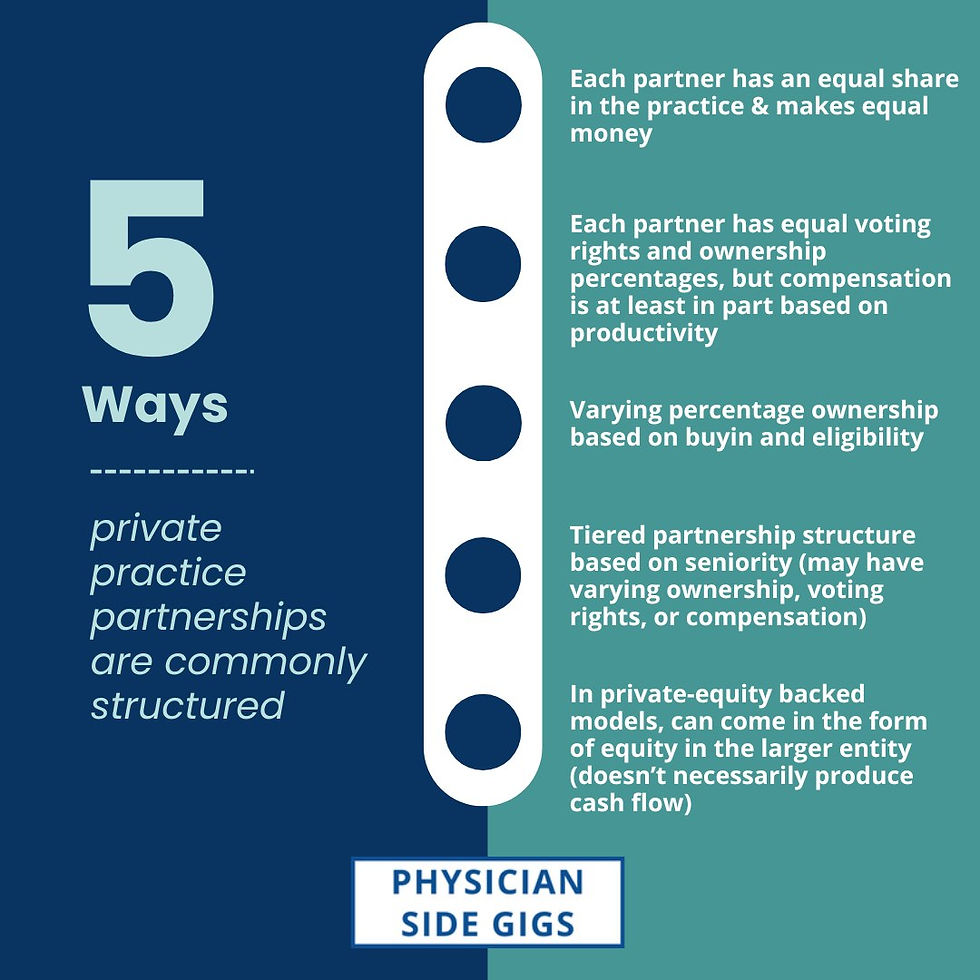
Every partner has an equal share in the private practice and makes equal money
In the most traditional group model, there is a collaborative partnership structure where every partner has equal voting rights, power, and earnings.
This partnership model typically works if everybody views their activities as synergistic and equally valued. The truth is that these days, outside of a few fields, this model is dying due to a number of factors:
More and more physicians working part time or on different schedules, making it harder to justify paying everyone the same, though this could be done in a pro-rated way
As specializations within a field increase, it’s harder to recruit if you don’t pay physicians according to the norms within their subspecialty. For example, most interventional cardiologists are paid more than non-invasive cardiologists within the same group, and also may have more onerous call, etc.
As the focus shifts increasingly to productivity, more physicians are arguing that they should be paid more if they are higher producers, so even within traditionally equitable groups such as radiology, at least a portion of the earnings are increasingly tied to productivity.
Still, some groups where there is more of a team oriented culture towards getting a variety of tasks done, such as radiology and pathology, are more likely to have equal pay.
Each partner has equal voting rights and ownership percentages, but compensation is also based on productivity (“eat what you kill”)
This is a very common model within partnership structures these days, especially in fields where there are a procedural component or subsections within the group that have vastly different compensation. Most surgical subspecialties and IM procedural specialty groups follow this model.
In these cases, there is often shared overhead, as well as some shared revenue from ancillary revenue streams such as real estate or employee earnings, but a significant component of the compensation is generated based on what you yourself generate in collections. While this incentivizes everyone to work as hard as possible, it can create some internal tension from the lower earners in a group.
Varying percentage ownership based on buyin and eligibility
Many practices don’t give you exposure to all of the revenue streams of the practice all at once, or similarly may limit your voting rights or percentage ownership. The benefit of these types of practices may be that you have exposure to some baseline level of partnership and upside earlier, but that you have a more prolonged pathway to becoming equal to the partners in the practice with the most authority and revenue.
Tiered partnership structures based on seniority (may be varying ownership, voting rights, or compensation)
Some groups, particularly those that have been around for a long time, have enacted tiered structures to partnership based on seniority. This means that there may be a tier of partners who always make more money, share in more revenue streams, or have special voting rights. Particularly in an era where private equity buyouts have become more common, senior partners are increasingly wanting to keep a larger share reflecting their contribution to building the practice.
However, while it may make sense for the partners who built the practice to have some extra perks, they should be careful about how this may disincentivize potential junior partners from joining the group or existing junior partners from producing more or being more invested in the future of the practice.
As such, the most successful groups with tiered partnership structures tend to offer a pathway for junior partners to graduate to senior status so that they are still incentivized to build the practice in the way that older partners were.
Private equity backed partnership options
For groups that have already sold a portion of their practice to private equity, partnership can become even more complicated. Here, your partnership is generally in the form of equity of the larger entity, and the value of your shares may be tied to factors beyond your control. You won’t necessarily get cash flow from your ownership the way you would as a private practice partner, but rather, your upside to being a “partner” may only be if there is a future second (or third, etc.) event sale that allows you to capitalize on the interval appreciation of your shares.
Learn more about private equity backed private practices.
What are different ways that private practice partnerships can be financed?
The amount of the practice buy in is highly variable depending on the assets of the practice and how big of a practice it is, as well as how many partners there are that this value is divided amongst. That said, most practice buyins on our physician salary and negotiation database are reported as being between $50,000 and $450,000.
If you have a very large buyin, chances are that you’re not going to have this amount of cash on hand, and fortunately, most practices recognize that. Therefore, there are different options that they may offer you, some of which can be done as hybrid models. These involve:
Paying yourself through your savings or cash that you have available to you
Financed by the practice by ‘borrowing’ the cash from the practice at an interest rate that you will pay back from your earnings over time
Sweat and/or financial equity earn ins from your paychecks before granting partnership
Financed by a loan through the practice’s bank or lender financing that you secure on your own
If you need help financing your practice buyin, we have some options.
Bank of America
When you need financing for your medical practice, you want to work with someone who understands your industry. For over twenty years, Bank of America Practice Solutions has helped doctors across the nation reach their goals through smart financial solutions1 and expert guidance. Whether you own a practice or are just getting started, we can provide customized financial help for your short-term needs and long-term aspirations.
Purchase and start-up:
Practice sales and purchases
New practice start-ups
Owner-occupied commercial real estate products2
Growth and restructuring
Improvement and expansion financing
Equipment financing
Practice debt consolidation3
Expert guidance. Personal attention. Real solutions.
To learn more, reach out to Shane Young, 951.809.7855 or shane.young@bofa.com.
1 All programs are subject to credit approval and loan amounts are subject to credit worthiness. Some restrictions may apply.
2 For Owner-Occupied Commercial Real Estate loans (OOCRE), terms up to 25 years and 51% occupancy are required. Real Estate financing options are subject to approval and product availability is subject to change. For SBA loans, SBA eligibility and restrictions apply.
3 Bank of America may prohibit use of account to pay off or pay down another Bank of America account.
4 To be eligible for this reduction, applicants must provide association name and membership number at time of approval.
Bank of America is a registered trademark of Bank of America Corporation. Bank of America Practice Solutions is a division of Bank of America, N.A. ©2019 Bank of America Corporation | MAP#3249875
Learn more at bankofamerica.com/practicesolutions
Disclosure: Bank of America is a sponsor of our Private Practice Education Series and partner of ours, which means that we may earn a referral fee if you decide to contact them.
Doc2Doc Lending
Founded by PSG members, offers personal loans of up to $100,000 to physicians. The program was founded by doctors for doctors who understand the financial realities of training and early practice. There are no prepayment penalties, a 0.25% autopay discount, and fast funding. Learn more with our affiliate link.
Conclusion
While most employed physicians likely join private practices hoping to become a partner, it’s important to understand that partnership can look very different in different practice environments and group models. It’s important to ask lots of questions when considering a private practice that you want to join to ensure that you can capture the upside potential that you’re going for. Recognizing this upfront will help you weed out opportunities that don’t give you the level of autonomy or compensation that you seek.
Additional private practice partnership resources for physicians
Sign up for our weekly newsletter for alerts about upcoming related free webinars, additional educational resources and more.
Related PSG resources: