


Which Medical Specialties Get the Most QME Cases?
Physicians in our physician social media communities considering Qualified Medical Evaluator (QME) work often ask the same question: Which specialties receive the most QME cases? Since QME work can become a meaningful source of supplemental income and professional diversification, but also requires the upfront commitment of pursuing certification, it's important for physicians to understand where demand exists before devoting the time and energy to the process. We regularly see physicians asking whether becoming a QME is worthwhile and whether their specialty is "good enough" to build a successful med-legal practice. The reality is that while specialty certainly influences demand, physicians who consistently receive the highest case volumes typically combine clinical expertise with smart geographic planning, efficient operations, and high-quality report writing. Below, we'll cover the specialties that get the most QME work, but also how other specialties can maximize the cases that they get if they don't fall into one of those specialties.
Disclosure/Disclaimer: This page contains information about our sponsors and/or affiliate links, which support us monetarily at no cost to you. These should be viewed as introductions rather than formal recommendations. Our content is for generalized educational purposes. While we try to ensure it is accurate and updated, we cannot guarantee it. Rules/laws can change frequently. We are not formal financial, legal, or tax professionals and do not provide individualized advice specific to your situation. You should consult these as appropriate and/or do your own due diligence before making decisions based on this page. To learn more, visit our disclaimers and disclosures.
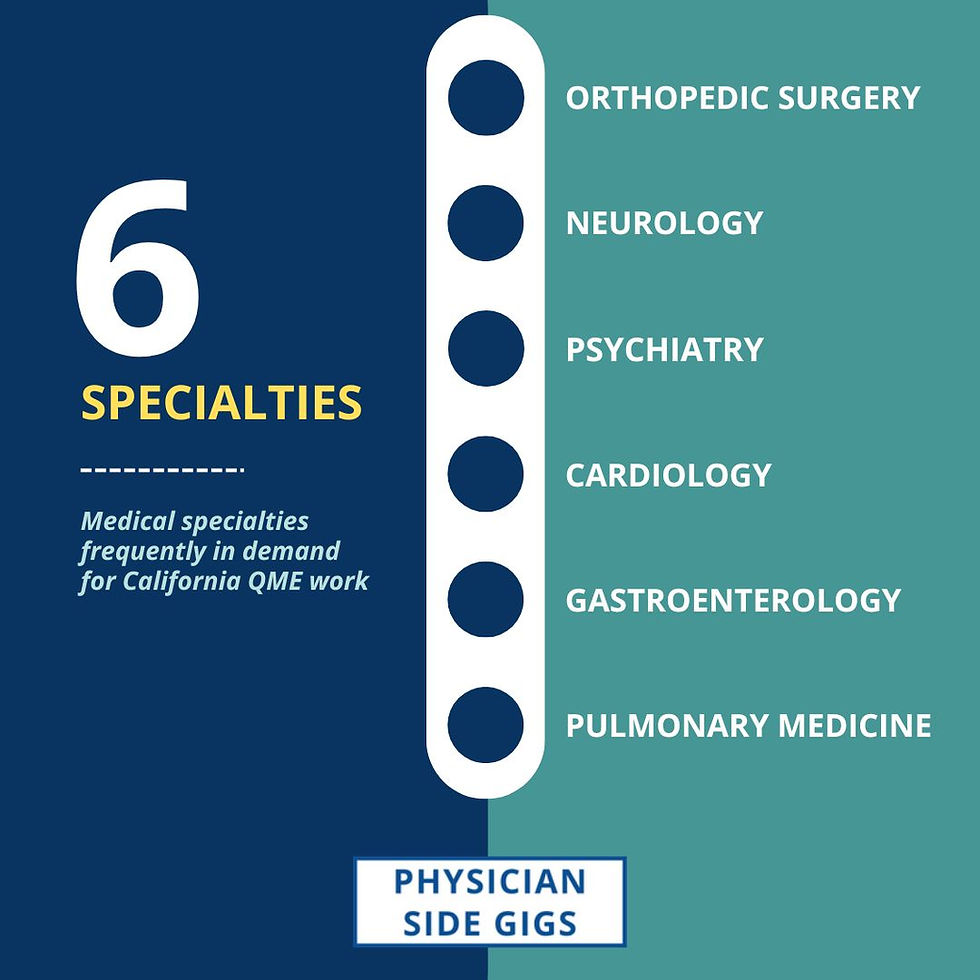
Which medical specialties receive the most QME cases?
In California, several specialties consistently experience strong demand for Qualified Medical Evaluator (QME) work because they frequently evaluate injuries and illnesses commonly seen in Workers' Compensation claims. These specialties include:
Orthopedic Surgery
Neurology
Psychiatry
Cardiology
Gastroenterology
Pulmonary Medicine
These physicians commonly evaluate musculoskeletal injuries, neurological disorders, psychiatric conditions, cardiovascular disease, gastrointestinal disorders, and respiratory complaints that arise during Workers' Compensation cases. However, being in one of these specialties does not automatically guarantee a busy QME practice.
Why specialty demand is only one factor
QME case volume depends on much more than board certification. Factors that often have just as much—or even greater—influence include:
Clinic location
Physician availability
Report quality
Report turnaround time
Administrative support
Professional reputation
The QME company that you're working with
For example, a physician in a moderately demanded specialty may ultimately perform more evaluations than someone in a traditionally high-demand specialty if they:
List the maximum number of permitted clinic locations
Evaluate patients in underserved regions
Submit organized, defensible reports
Return reports promptly
Offer reliable appointment availability
Develop a strong reputation among attorneys and claims professionals
Ultimately, QME success is often built on consistency rather than specialty alone. The QME company you choose to work with (if you choose to work with a company) can also have a significant effect on both your financial success and the long term sustainability of doing these exams.
If you're interested in doing QME work, we do have partners in the space. Sign up here to be matched with a PSG partner who can help facilitate this journey by helping with exam preparation, as well as the complexity of exam scheduling, preparation, and coordination, and compliance.
Use all 10 QME locations strategically
California allows Qualified Medical Evaluators to list up to ten office locations, and these locations are used during the panel selection process. Strategic location planning can therefore have a significant impact on how frequently your name appears on QME panels.
Areas with high case volume
Areas with physician shortages
Markets where competition is lower
However, interpreting this data requires careful analysis. Some regions generate a high volume of QME cases but also have a large number of available evaluators competing for those panels. Other areas may have fewer overall cases but significantly fewer QMEs, creating greater opportunities for physicians willing to practice there. Planning where to establish your ten office locations takes thoughtful strategy, and physicians who are willing to travel may receive substantially more evaluation opportunities.
For example, a neurologist practicing in a highly competitive metropolitan area may receive relatively few panel assignments. That same neurologist may become much busier by evaluating patients in nearby underserved regions. Although travel can be inconvenient, it may substantially increase both case volume and long-term income by creating a more predictable and profitable QME schedule.
Report quality affects future case volume
Writing excellent reports is one of the biggest long-term drivers of a successful QME practice. A strong QME report should be:
Organized
Well supported medically
Responsive to all legal questions
Understandable to non-physicians
Being an excellent clinician alone is not enough. Successful QMEs understand both the medicine and the legal framework in which medical-legal evaluations occur. It is not enough to be an outstanding physician—you must also understand the legal aspects of the med-legal system and how your opinions will be interpreted within it. Reports that are incomplete, overly technical, inconsistent, or delayed often result in:
Supplemental reports
Additional deposition requests
Fewer future referrals
One of the biggest mistakes physicians make is writing reports that are too medically focused while failing to address, understand, or anticipate the legal questions that ultimately determine how useful the report is to the parties involved. Reports should not simply summarize medical findings—they should clearly explain how the medical evidence supports each conclusion while directly answering the legal questions posed by the parties.
Physicians who consistently produce thoughtful, defensible reports tend to develop stronger reputations with attorneys, claims administrators, and the Workers' Compensation system as a whole. This often leads to more repeat evaluations, fewer disputes, and greater confidence from all parties involved. Timeliness also matters. Although physicians generally have 30 days to complete reports, there are many stakeholders involved in every Workers' Compensation case, and everyone appreciates reports that arrive sooner whenever possible.
Medium-demand specialties can still thrive
Physicians should not assume that QME work is only worthwhile for the traditionally high-demand specialties. Many physicians in medium-demand specialties build outstanding practices by combining:
Strategic office locations
Willingness to travel
Reliable scheduling
Strong medical-legal analysis
Consistently timely reports
Which specialties tend to get fewer QME cases?
That said, some specialties have historically generated relatively little QME demand, including:
Family Medicine
Addiction Medicine
Obstetrics & Gynecology
Emergency Medicine
Anesthesiology
Pathology
Pediatrics
Physicians in these specialties should not automatically dismiss QME work, but they should carefully research regional demand before investing the time and expense required for certification.

Conclusion
Your specialty influences QME demand, but it is only one part of building a successful QME practice. Physicians who carefully choose office locations, travel to underserved regions, consistently produce clear and defensible reports, and meet deadlines often build thriving QME practices—even in specialties with only moderate demand.
Physicians who strategically choose office locations, maintain excellent turnaround times, consistently produce high-quality medical-legal reports, and understand the legal framework surrounding Workers' Compensation often outperform peers who rely on specialty alone.
Related resources for physicians
If you're interested in doing QME work, we do have partners in the space. Sign up here to be matched with a PSG partner who can help facilitate this journey by helping with exam preparation, as well as the complexity of exam scheduling, preparation, and coordination, and compliance.
Sign up for our weekly newsletter for alerts about side gig opportunities, upcoming related free webinars, additional educational resources, and more.
Related PSG resources: