


How to Pick the Best QME Company to Work Alongside for Qualified Medical Evaluator Exams
For physicians entering the journey of doing Qualified Medical Evaluator (QME) work, choosing the right QME company can have just as much impact on their long-term success and earning potential as other factors such as specialty. While physicians are not required to work with a QME company in order to do QME work, many do not have the time, desire, or infrastructure to independently manage every aspect of a medical-legal practice. Building that infrastructure means securing office space, hiring staff, managing scheduling, maintaining compliance with legal deadlines, coordinating records, overseeing report editing, and handling countless administrative responsibilities.
We regularly see doctors in our physician communities on social media asking which QME companies are worth working with and what separates a great company from an average one. The answer extends far beyond scheduling evaluations. The best QME companies become long-term partners that help physicians build successful, sustainable medical-legal practices. Below, we'll cover what questions to ask and what factors to consider as you make your decision.
Disclosure/Disclaimer: This page contains information about our sponsors and/or affiliate links, which support us monetarily at no cost to you. These should be viewed as introductions rather than formal recommendations. Our content is for generalized educational purposes. While we try to ensure it is accurate and updated, we cannot guarantee it. Rules/laws can change frequently. We are not formal financial, legal, or tax professionals and do not provide individualized advice specific to your situation. You should consult these as appropriate and/or do your own due diligence before making decisions based on this page. To learn more, visit our disclaimers and disclosures.
Article Navigation
Who are the best QME companies to work with?
Like most side gig situations, there's no such thing as the 'best,' for everyone, but there is likely a company that you fit best with. Every QME company likely has its own strengths and weaknesses, and it's important for you to be honest with yourself about where you need support and where you don't. Below, we'll cover the questions that you should be asking based on the support we've seen physicians in our communities seeking, and what we've seen tend to lead to the most long term success, both financially and in terms of sustainability. If you're interested in doing QME work, we do have partners in the space. Sign up here to be matched with a PSG partner who can help facilitate this journey by helping with exam preparation, as well as the complexity of exam scheduling, preparation, and coordination, and compliance.
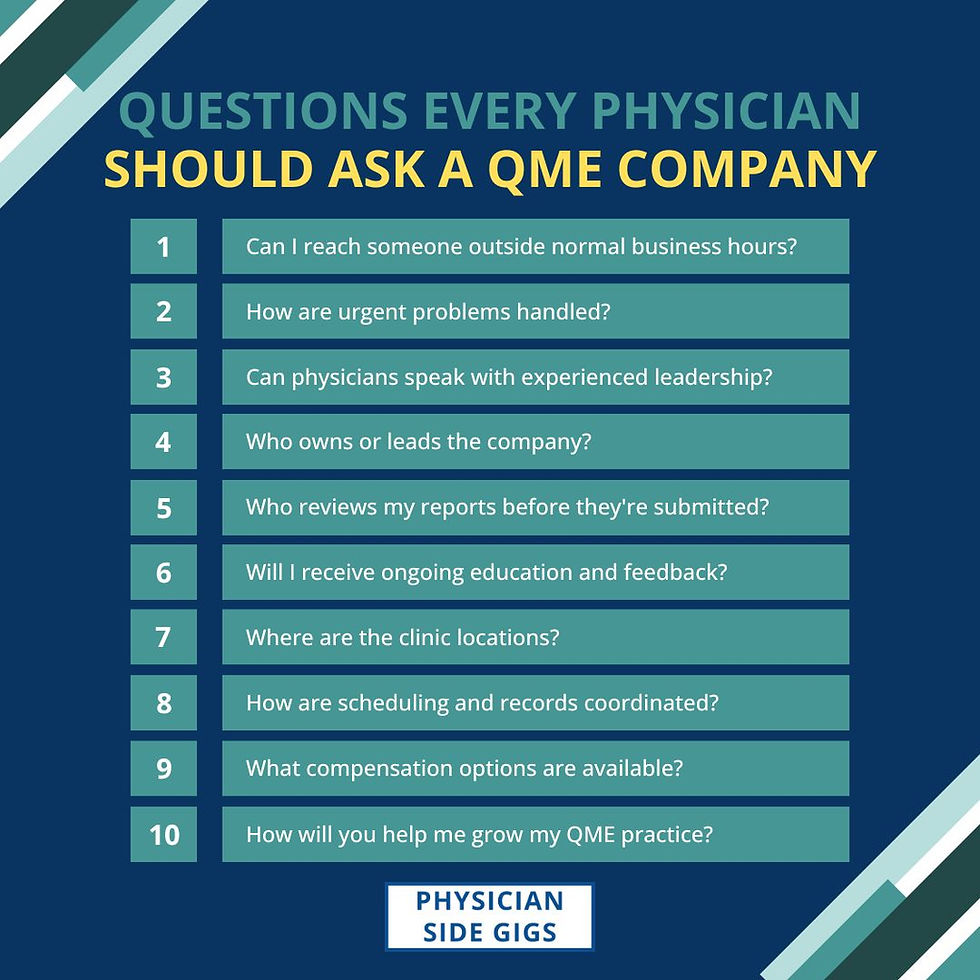
Can you reach someone when a problem occurs?
Medical-legal issues rarely occur at convenient times. Can you reach someone at 8:00 a.m. on a Saturday before a full evaluation day? Will someone respond if records are missing, an interpreter fails to arrive, or a clinic cannot be accessed?
A strong QME company should provide dependable support when physicians are actually working—not simply Monday through Friday during standard business hours.
Equally important is who you're speaking with. Physicians should have reasonable access to experienced managers, company founders, clinicians, or decision-makers rather than being routed exclusively through entry-level staff. Here are some questions to ask:
Is support available outside normal business hours?
Can physicians speak directly with experienced leadership?
How quickly are urgent issues resolved?
A Good QME company should teach you medical-legal medicine
A good QME company does far more than schedule evaluations. It should provide:
Report templates
Sample reports
Educational sessions
Practical guidance
Access to experienced reviewers
Ongoing feedback
Remember, the company is there to support you—not replace you. Physicians are still expected to invest time learning the medical-legal process. Simply inserting clinical findings into a template is not enough. Physicians should understand how medical opinions are interpreted within California's Workers' Compensation system.
The best QME companies act like a trusted mentor. Good reviewers challenge assumptions, identify weaknesses, and help physicians continually improve their reports over time.
Does the QME company offer more than one compensation model?
Not every physician wants the same arrangement. Some physicians prefer a percentage-based model, while others value the stability of a guaranteed daily rate that protects them from cancellations and time away from the clinic or the operating room. A well-run QME company may offer:
Percentage-based compensation
Guaranteed daily or clinic rates
Travel stipends
Housing assistance
Support obtaining and maintaining credentials
Flexible compensation demonstrates that the company understands different physician schedules, specialties, and financial preferences.
How strong is the editorial process?
Editing should involve much more than correcting grammar and formatting. Some QME companies may offer multiple layers of review with a combination of junior and senior editors.
While everyone understandably wants senior editors reviewing every report, there are practical realities. Senior reviewers are valuable but also expensive. Companies promising exceptionally high physician compensation and unlimited senior-level editing may eventually struggle to maintain those promises. Instead, ask:
How many people review each report?
Are senior editors available when needed?
Are editors trained in medical-legal analysis?
Does the review identify conflicting opinions?
Will feedback help improve future reports?
Strong editing protects both report quality and your professional reputation.
Does the QME company support multiple specialties?
Some companies focus primarily on orthopedic surgery or psychiatry. That doesn't necessarily make them ineffective—but broader specialty experience often means broader operational experience. Companies that support a lot of specialties (including but not limited to gastroenterology, cardiology, neurology, internal medicine, pulmonary medicine, pain medicine, and ophthalmology) often develop more adaptable reporting systems rather than relying on one standardized workflow for every physician, as well as understand the various constraints of each specialty in scheduling better.
Are physicians involved in leadership of the QME company?
Physician leadership matters because physician experience matters. Many physicians have worked within large healthcare organizations where operational decisions are made by individuals far removed from clinical practice. A company with physicians involved in ownership, leadership, or advisory roles may better understand:
Reviewing hundreds of pages of records
Completing complex evaluations
Dictating lengthy reports
Responding to supplemental requests
Balancing QME work with a busy clinical practice
When evaluating companies, physicians should also review publicly available information regarding disciplinary actions, regulatory findings, fraud allegations, criminal convictions, or other issues that could create operational or reputational concerns. Sometimes, companies without physician leadership may be more prone to prioritizing profits over the people the QME system is designed to serve, and physicians are very attuned to the need to put patients above all else.
Can the QME company reliably provide clinic locations?
Reliable clinic access is essential to building consistent QME volume. Companies advertising unusually inexpensive clinic space may not have a sustainable long-term business model. You should ask:
Can they provide actual clinic addresses?
How long have those clinics been operating?
Will they expand into new locations?
Are they willing to lease or purchase additional offices as your practice grows?
Stable clinic infrastructure helps minimize canceled evaluation days and scheduling disruptions.
Does the QME company want to grow with you?
The strongest QME relationships are partnerships—not transactions. A great company should help physicians:
Expand office locations
Enter underserved markets
Improve scheduling efficiency
Coordinate travel
Obtain additional licenses
Transition compensation models as case volume grows
Ultimately, the company should succeed when the physician succeeds.

Conclusion
A good QME company should provide far more than scheduling and billing. It should offer responsive leadership, physician-centered education, strong editorial review, dependable clinic infrastructure, flexible compensation options, and a long-term strategy for physician growth.
Before signing any agreement, ask difficult questions. Understand who reviews your reports, how clinic locations are maintained, how quickly problems are addressed, and whether the organization has the operational experience to support your specialty.
The right QME company allows physicians to focus on practicing medicine while providing the structure needed to produce timely, defensible, high-quality medical-legal reports.
Related resources for physicians
If you're interested in doing QME work, we do have partners in the space. Sign up here to be matched with a PSG partner who can help facilitate this journey by helping with exam preparation, as well as the complexity of exam scheduling, preparation, and coordination, and compliance.
Sign up for our weekly newsletter for alerts about side gig opportunities, upcoming related free webinars, additional educational resources, and more.
Related PSG resources:
Doing Qualified Medical Evaluator (QME) Work as a Physician Side Gig
How Much QME Work Pays, & Factors that Influence How Much Physicians Make
A Typical Day as a Qualified Medical Evaluator (QME): Responsibilities and Workflow
Physician Contracts: Navigating Side Gigs Restrictions from Employers
Common Questions Asked by Physicians Considering or Starting Expert Witness Work