


How Does the Big Beautiful Bill Impact Physicians?
Updated: Jul 14, 2025
The recent passage of the ‘Big Beautiful Bill’ (2025 Reconciliation Bill) in Congress has led to many posts on our online physician communities from doctors wondering what the impact of the bill will be for their patients, their practice, and their personal finances in regards to taxes, student loans, and estate planning. Putting politics aside, these are some things that physicians should know about how the bill may affect their everyday lives, and those of their patients.
Given the size of the bill and how recently it has passed, as well as the fact that portions of it are subject to interpretation or may be implemented in different ways, it remains to be seen what the final effects may be. Additionally, not every physician is the same. As such, you should do your own due diligence and consult with appropriate expertise before making any decisions on the basis of this information. We will try our best to update it as more information and analysis emerges.
Disclosure/Disclaimer: This page contains information about our sponsors and/or affiliate links, which support us monetarily at no cost to you. These should be viewed as introductions rather than formal recommendations, and often provide you with perks, so we hope it's win-win. Our content is for generalized educational purposes. While we try to ensure it is accurate and updated, we cannot guarantee it. Rules/laws can change frequently. We are not formal financial, legal, or tax professionals and do not provide individualized advice specific to your situation. You should consult these as appropriate and/or do your own due diligence before making decisions based on this page. To learn more, visit our disclaimers and disclosures.

How the Big Beautiful Bill impacts healthcare
The bill results in more than $1 trillion in cuts to healthcare, of which the vast majority comes from cuts to Medicaid.

Medicaid cuts from the Big Beautiful Bill
The bill adds new work requirements for Medicaid eligibility, co-pay requirements, and restricts how much federal support that states get for Medicaid, shifting more of the burden of paying for Medicaid to the states and hospitals.
Starting in December 2026, adults under the age of 65, including low-income parents of children older than 14, will need to prove that they work, volunteer, or attend school for at least 80 hours a month to qualify. This will also result in more infrastructure needed by the state to verify the work status of each enrollee at least every 6 months. Many worry that this administrative burden alone and the need for people to continuously comply with it (including filling out the right forms at the right time) will result in many people losing access to Medicaid.
Pregnant women, the disabled, and those in prison or rehab centers are exempt from the requirements.
Those with income above the poverty line may now have to pay co-pays for Medicaid services out of pocket up to a certain % of their income per year. This will depend on the service, with some exemptions for primary care, mental health, and substance abuse.
According to the (nonpartisan) Congressional Budget Office, an earlier version of the bill was estimated to lead to 11.8 million more uninsured Americans by 2034. There is not yet an update to those numbers by the CBO.
Bans federal Medicaid funds from going to clinics that perform abortions, even if abortion is legal in the state
This will likely have a large impact on physician practices and healthcare organizations who have a large Medicaid population. It’s too early to say what the ripple effects will be, but many in our communities speculate that they will include decreased access to care, physician pay cuts, job cuts, and potentially the closure of hospitals and practices.
Physician Medicare fee schedule reimbursement
The Bill includes a (one year) 2.5% increase to the Medicare Physician Fee Schedule for 2026
Rural hospitals
Congress did allot $50 billion in funding for rural hospitals. However, most physician, hospital, and healthcare advocacy organizations have said this would not come close to making up for the cuts to Medicaid and other health programs, and worry about the ability for these hospitals to survive and access to care.
This could result in overcrowding of the emergency room and much more uncompensated care for clinicians and institutions delivering the care.
Affordable Care Act exchanges and subsidies
The Bill limits eligibility for the premium subsidies to people residing in the US that are not eligible for any other federal insurance program, and may affect the ability of lawful immigrants and permanent residents to get subsidies.
Delays when patients can begin receiving access to a subsidized plan, as currently there is a 90 day grace period while eligibility is confirmed. In this bill, eligibility would need to be determined prior to being able to use the plan.
Automatic reenrollment will no longer be an option, and eligibility will need to be determined every time.
Telemedicine
The bill will permanently allow high deductible health plans to cover telehealth and other remote services before the deductible and still qualify as an HSA-eligible HDHP that allows for HSA contributions. Of note, what classifies as telehealth and remote services is not defined in the bill, so it remains to be seen how this is put into practice.
Direct Primary Care (DPC)
Effective Jan 1, 2026, some DPCs that offer primary care services will no longer be considered health plans, which is important because it will allow patients under these arrangements to be eligible for a health savings account.
There are conditions to this, including how much the fees can be monthly, and what services can be provided (not services that require anesthesia, non-vaccine prescription drugs, or lab services not typically administered in a primary care setting), so look into these when making decisions based on this information.
The fees paid to any DPC can be treated as a medical expense rather than payment of insurance fees, which can then be paid for with HSA funds.
How the Big Beautiful Bill affects personal taxes for doctors

Tax brackets
The seven tax brackets will remain the same (bottom rate 10%, top rate 37%). What income levels fall within each bracket may change. See current tax brackets in 2025 here.
SALT deduction
The current cap on the State and Local Tax (SALT) deduction of $10,000 will increase to $40,000 until 2030, at which point it will go back to $10,000. BUT - this phases out on the basis of income, starting with income over $500,000.
Standard deduction
The increase in the standard deduction that had been doubled in 2017 is permanent, and increases to $15,750 for single filers, $23,625 for head of household, and $31,500 for joint filers, with subsequent indexes to inflation after this year.
Mortgage deduction
$750,000 (joint filers) and $375,000 (single filers) principal limit for the home mortgage interest deduction has become permanent.
Lifetime gift and estate tax exclusions and provisions
The 2017 legislation had steadily increased the estate tax exclusions to double what they were previously, and these were set to reverse at the end of the year. This bill permanently increased the estate and lifetime gift tax exemption to $15 million for single filers and $30 million for joint filers beginning in 2026, and allows for increases indexed to inflation going forward.
Child tax credit
The bill made permanent the 2017 increase (currently $2,000), and will increase to $2,200 in 2026. This will also be adjusted for inflation going forward. Note that this may not apply to all physicians, as eligibility for this credit is income dependent.
Alternative minimum tax exemptions
The bill makes the increase in the alternative minimum tax (AMT) exemption permanent, but reverts the AMT exemption phaseout thresholds to 2018 levels of $500,000 for single filers and $1 million for joint returns. These will be indexed for inflation in the future.
Miscellaneous
Variably applicable to physicians, there are several other temporary provisions in the bill for things like taxes on tip and overtime, deductible car loan interest, and additional senior tax deductions. There are income requirements on all of these that may phase out many physician families.
There are also expanded uses for 529s, including tutoring, testing fees, educational therapy for children with disabilities, and other provisions.
How the Big Beautiful Bill affects doctors with student loans
Perhaps the most important point here is that there is still a lot in the air, and you should likely take a minute to process the changes, do some math and model out scenarios, and consult with appropriate financial expertise prior to making changes that you can’t undo. For example, we anticipate that student loan refinancing will become more attractive for some doctors, but remember that once you leave the federal loan system, you cannot reenter it. There are also mixed reports about what certain provisions mean, so again, please do your due diligence as this information may not be the most up to date depending on when you read this.
This whole scenario is more complicated for future borrowers, but as most of the people reading this are physicians already, we will focus on those currently carrying student loans in this article.
That said, it’s important to note that in general, student loans will get more complicated for current and future medical students, with new caps on borrowing (the bill delineates < $100,000 for a master’s degree and < $200,000 for doctoral, medical or professional degrees). The average medical student carries more than this in loans. The bill will also phase out the federal Grad PLUS loan program, Parent PLUS loans are also going to have a cap, and hardship deferments will be further restricted. All of these changes will undoubtedly affect future generations of physicians and the decisions they make.
Public Student Loan Forgiveness (PSLF)
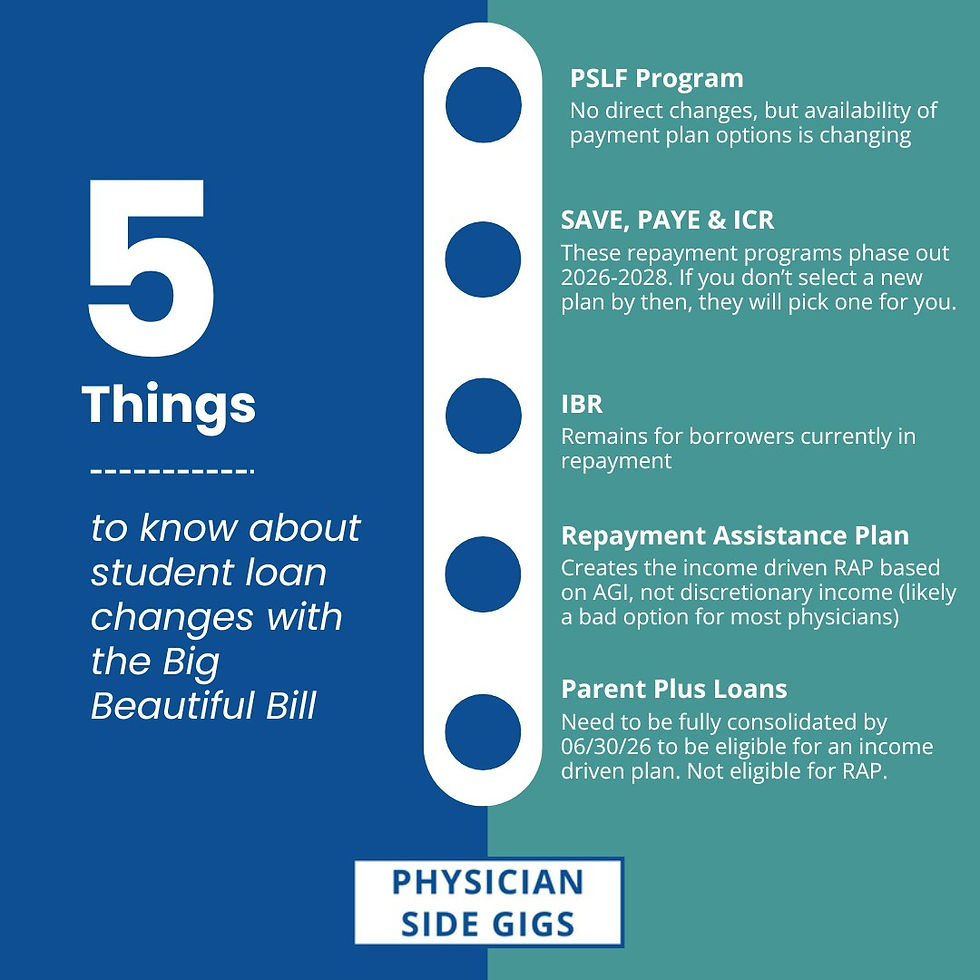
This bill does not directly change the Public Student Loan Forgiveness (PSLF) program, but does affect the available payment plan options.
SAVE, PAYE, and ICR repayment programs
The Saving on a Valuable Education (SAVE), Pay As You Earn (PAYE), and Income-Contingent Repayment (ICR) plans are set to phase out between 2026 and 2028, and therefore, anybody on these plans will at some point before 2028 have to choose a new repayment plan. The important thing to note is that if you do not pick a new repayment plan by then, they will pick one for you.
The decision on the SAVE plan could come a lot sooner given the pending court case.
Learn more about additional changes to the SAVE repayment program.
If you need help navigating your options, we have a partner who can help.
Related PSG Perk:
Grad Loan Advice™ can help you optimize your student loan repayment strategy. Every consultant at Grad Loan Advice™ is a Certified Student Loan Professional (CSLP®), bringing expertise and clarity to the often-confusing world of student loans. Through a 1-hour consultation, they’ll break down your options in detail, empowering you to make informed decisions about your debt. Whether you’re navigating changes brought by the One Big Beautiful Bill Act or exploring repayment strategies for the first time, Grad Loan Advice™ is here to guide you. PSG members receive $50 off when you schedule your consultation today through our dedicated partner page.
Income Based Repayment (IBR) plan
The IBR plans will stay for borrowers who are currently in repayment. For borrowers who took out loans before July 2014, that means you pay 15% of your discretionary income for forgiveness at 25 years (if you’re not going for PSLF). For borrowers who took out loans after July 2014, that means you pay 10% of your discretionary income for forgiveness at 20 years (if you’re not going for PSLF). There remain caps on payments to the 10 year standard repayment plan based on the balance you had at the time you entered the plan. Married borrowers can still file taxes separately to exclude the spouse’s income for purposes of calculations.
Creation of the Repayment Assistance Plan (RAP)
The bill creates a new income driven plan called the Repayment Assistance Plan (RAP), which starts in July 2026 and has a 30 year repayment plan, and would calculate your payments based on your AGI, NOT your discretionary income. There is a complex scale to determine what percentage of your income your payment is based on, but for anybody making more than 100k, it will be limited to 10%. This will almost definitely be a bad plan for most doctors to be enrolled in for 30 years, and for high earning physicians, could result in extremely high payments even for those going for PSLF.
Going forward, new borrowers will have to choose between this and the standard repayment plan.
Parent PLUS Loans
This is a big change, and is time sensitive. Essentially, all PPL borrowers need to be fully consolidated by June 30, 2026 to be eligible for an income driven plan going forward. They will not be eligible for RAP. There are more nuances to this, but those with Parent Plus Loans should figure out a plan as soon as possible.
How the 2025 reconciliation bill affects doctors with side gigs and businesses
Additional changes may apply to your specific side gig, but these are the ones we feel are most applicable to popular physician side gigs.

Qualified Business Income (QBI) deduction, also known as Section 199A
The bill made the 20% QBI deduction (also known as the Section 199A pass-through deduction) permanent. This deduction was set to expire in 2025. The qualified business deduction is a potentially very large deduction for income earned through qualifying businesses. The deduction will stay at 20%, but SSTB phaseouts are being raised. Additionally, if you have $1,000 in qualified business income and otherwise qualify, you now get a new $400 minimum deduction even if the normal 20% rule would give you less of a deduction.
This also applies to REITs for those physicians investing in real estate through these entities.
Learn more about the QBI deduction and if you qualify.
Bonus depreciation
The bill restores 100 percent bonus depreciation for short-lived investments. This could be huge for those investing in assets which depreciate, such as real estate, as this is one of the tax benefits of investing in real estate. We are awaiting guidance on whether this is permanent or just applies to qualifying property placed in service on or after Jan. 20, 2025, and before Jan. 1, 2030, and recommend checking with an accountant familiar with real estate investing, such as one listed on the article above.
1099 reporting threshold
The bill raises the reporting threshold for Form 1099-NEC and Form 1099-MISC to $2,000 from $600 starting in 2026, and allows for annual inflation adjustments, which affects those that receive 1099s as independent contractors, as well as those that issue them to independent contractors.
Conclusion
The passage of the new 2025 Reconciliation Bill, referred to as the Big Beautiful Bill, will have large implications for healthcare as well as the professional and personal lives of physicians. Above, we outlined some of the highlights of the bill that are most pertinent to doctors. We again emphasize that the legislation is fresh and that you should await further guidance or talk to a licensed professional before making decisions based on this information, but hope it will help provide some clarity on the major provisions of the bill.
Related resources for physicians
Explore our: