


Family Medicine Physician Salaries By State: Where Do They Make the Most Money?
Updated: Apr 4
As location impacts physician compensation, salaries within a specialty can vary significantly depending on geography. Institutions and practices in rural areas will often pay a premium to help recruit physicians, and on the opposite end of the spectrum, urban areas may need to compensate with higher amounts secondary to the elevated cost of living in a city. Many doctors consider geographic arbitrage to help their hard earned dollars go further or to be able to pay off student loans. Below, we look at average salaries for family medicine by state, and see where doctors make the most, as well as provide information about the cost of living in each of these states so that informed decisions can be made. This analysis was compiled using data from the physician compensation & negotiation database we offer as a free resource to our online physician community.
Disclaimers/Disclosures: This information is derived from our physician salary and compensation databases, but is subject to self-reporting errors and availability of relevant data points from our online communities. This information is provided for educational purposes only, and is aimed at advocating for individual physicians. It is not intended to be used for collective bargaining; please see additional disclosures and disclaimers on the physician salary data pages. Please also do your own research before making any decisions based on the information provided. We are not formal financial, legal, or tax professionals and do not provide individualized advice. You should consult these as appropriate. We highly recommend having your physician employment agreement reviewed by a physician contract review attorney to ensure you have the most up to date and relevant information for your specific situation.

National Average Compensation Family Medicine Physicians Earn
Across the US, the average salary for a full-time (1 FTE) family medicine doctor was $314,000 from our 2025-2026 data.
Related PSG resource:
Average Family Medicine Salary by State
We ran the analysis of our 2023-2025 salary data to find average annual salaries for family medicine physicians across the country who worked on average 36+ hours a week. We required a minimum number of data points for each state to help provide relevant data; therefore, not all states are listed below. If you don’t see your state, please take a few minutes to contribute your anonymous physician data to support updates to this article and allow us to provide additional insights.
Alabama $286,000
Arizona $326,000
Arkansas $320,000
California $328,500
Colorado $271,000
Connecticut $285,000
Florida $300,500
Georgia $293,000
Illinois $283,000
Indiana $281,000
Iowa $325,500
Kansas $287,000
Kentucky $374,500
Louisiana $276,500
Maryland $288,000
Massachusetts $286,500
Michigan $273,500
Minnesota $326,500
Missouri $306,000
Nebraska $332,000
Nevada $323,000
New Jersey $327,000
New York $288,500
North Carolina $305,000
Ohio $292,000
Oklahoma $318,500
Oregon $279,000
Pennsylvania $276,500
South Carolina $330,500
Tennessee $251,500
Texas $297,500
Virginia $285,000
Washington $304,000
Wisconsin $335,500
Data sets by state are inherently smaller than our full compensation data, and are still subject to the influence of outliers, reporting errors, etc. As always, when evaluating compensation data, we highly recommend working with a contract review and negotiation attorney who understands the local markets and the most recent trends.
Highest Paying States for Family Medicine Physicians
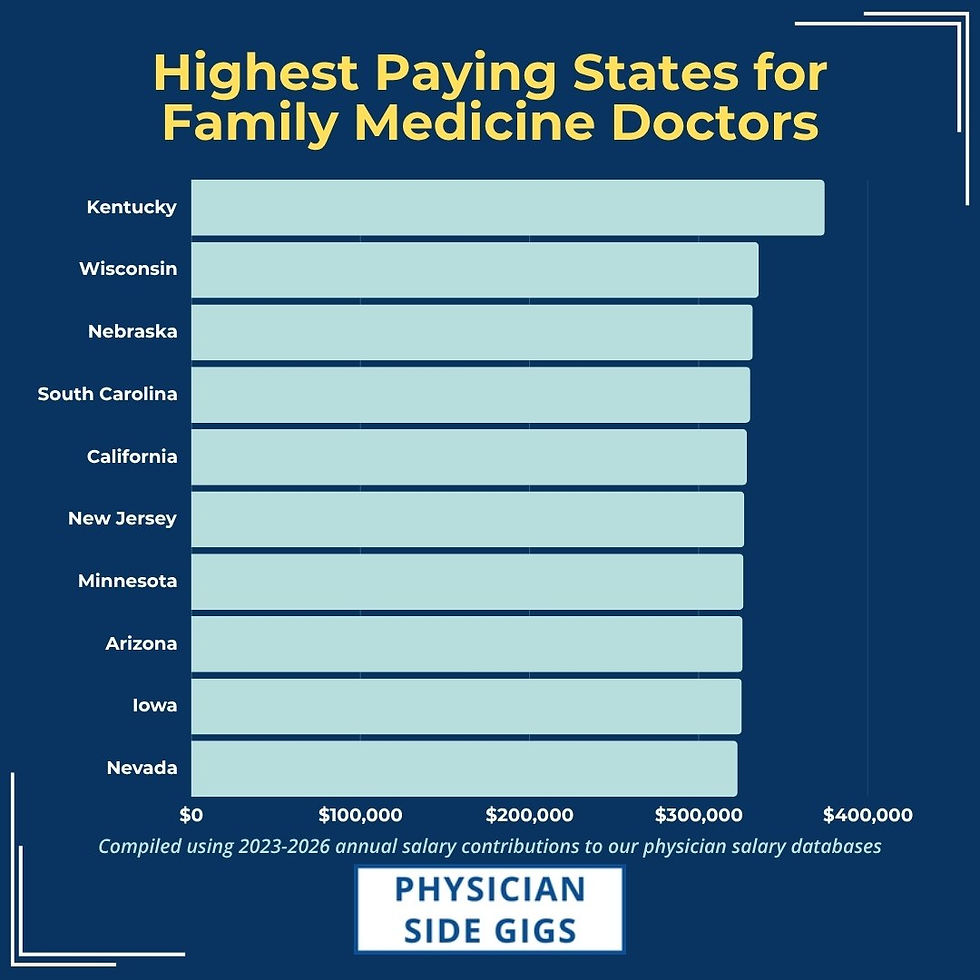
From the data we have available for the 34 states above, the highest reported average annual salaries for family medicine doctors were:
Kentucky $374,500
Wisconsin $335,500
Nebraska $332,000
South Carolina $330,500
California $328,500
New Jersey $327,000
Minnesota $326,500
Arizona $326,000
Iowa $325,500
Nevada $323,000
How to Factor in Cost of Living for Optimal Geographic Arbitrage
Remember that the highest-paying states don’t necessarily align with the highest (or lowest) cost-of-living areas in the country, which can allow doctors to engage in geographic arbitrage to find the best balance of cost of living with salary for their situation. While we haven’t looked at this factor specifically for family medicine doctors, we have assessed how average salaries across specialties compare to the cost of living by state.

Related PSG resource:
Where Do Doctors Take Home the Most?
This question is as important as where doctors are paid the most, as it considers not only the salary but also taxes and the cost of living. While we don’t have enough data to draw conclusive insights, some of the states that offer the highest salaries and have lower costs of living include:
Iowa
Kentucky
Wisconsin
If you’re looking to geo-arbitrage, these are areas that might be worth considering, though you should assess the entire opportunity and not just the salary offered. You’ll want to enjoy the community you live in and the lifestyle available there for long-term success and satisfaction.
What Factors Influence Family Medicine Physician Salaries Across the Country?
Key factors that can drive salaries by state include:
Cost of living: States with high costs of living often offer larger salaries to help offset the higher expenses
Supply and demand: Physician shortages can dictate higher pay to help draw in physicians
Payer mix: States that have a high population of Medicaid patients may have lower average salaries
Working in underserved areas can offer additional benefits such as PSLF eligibility, state or federal student loan repayment programs, and relocation bonuses that aren’t included in the average salaries above.
Related PSG resource:
Factors that also impact salaries, regardless of location, include:
The practice environment: Private practice versus academic, etc.
Compensation model: Straight salary, RVU-based, hybrid, etc.
Employment type: Practice owner, W-2 employee, 1099 contractor, etc.
We’ve looked at how these factors influence salaries in our article on how much family medicine doctors make.
Conclusion
Relocating for a family medicine job can be a major financial and lifestyle upgrade if it’s the right fit–or a frustration that soon has you looking for another job if it isn’t. The highest paying offer isn’t always the best one once you factor in other influences such as lifestyle, cost of living, and workload expectations. If you’re considering relocation, it’s important to understand the local markets—not just how much you can make, but how much you’ll keep and what lifestyle that affords in a given city or state.
Related Resources for Physicians
Sign up for our weekly newsletter for updates on new articles, insights into physician compensation data, free webinars, and more.
Sign up for our free Transition to Practice Series for graduating residents and fellows and early career attendings for free programming throughout the year to help you navigate the job search and negotiation processes.
Job search resources for doctors:
Resources for relocating:
Guide to relocating and buying your first house after training
Guide to physician licensing (includes a member discount on licensing services)