


AI Model Training Side Gigs for Physicians
Healthcare represents a fifth of the US GDP, so it’s no surprise that companies throughout the country are rushing to innovate in this space. As so many of these companies involve the use of AI, the need for medical expertise to train these models has never been greater, opening the door for lots of physician side gigs in the space. Over the last year, many physicians in our online physician communities have been approached about AI training side gigs. We see so many questions about what the job entails, whether we need to be worried that the technology is being created to replace physicians, and whether it’s worth it to participate in these side gigs. Below, we’ll discuss what you’ll be asked to do, what the compensation is like, flexibility, and other things to know before accepting a side gig in the AI model training space.
Disclosure/Disclaimer: Our content is for generalized educational purposes. While we try to ensure it is accurate and updated, we cannot guarantee it. We are not formal financial, legal, or tax professionals and do not provide individualized advice specific to your situation. You should consult these as appropriate and/or do your own due diligence before making decisions based on this page. To learn more, visit our disclaimers and disclosures.

Article Navigation
What does AI model training mean, and what do AI side gigs for physicians involve?
Are these AI training side gigs flexible and remote? What commitments do they require?
How am I paid for this work? Am I a W-2 employee or a 1099 independent contractor?
What questions should I ask before taking on an AI side gig?
What red flags in AI model training side gigs do I need to be aware of?
What does AI model training mean, and what do AI side gigs for physicians involve?
The term AI side gig is very vague, as these projects can be quite different from each other.
Most of the time, when physicians on our communities are talking about these projects, they are referring to projects where physicians are being helped to help train and improve AI models that are being deployed in healthcare, rather than actually participating in the delivery of healthcare. This work is very different than advisory, consulting, or expert witness work where you’re directly weighing in on a particular situation; instead, you’re helping improve the AI that’s being built in the healthcare field by actually teaching the AI to do its job better.
The complexity of these projects varies quite a bit. Some examples of projects include:
Labeling images
Identifying important information that the AI models should be extracting from documents, medical records, labs, etc.
Verifying that an AI tool has done its job correctly
Evaluating AI generated answers to medical questions based on accuracy and/or offering it areas for improvement
Identifying hallucinations or flaws in the models
Comparing outputs from various AI algorithms to determine which outputs are the best
Providing inputs that the AI models can use when generating the output (for example, writing answers to commonly asked medical questions)
Challenging existing models to see where they thrive and where they fail
Reviewing or creating the reasoning process used to generate responses to questions
Finding appropriate sources for models to pull data from or train on
Looking at generated reports from radiology, pathology, dermatology, or other specialties where AI is being used to generate preliminary reports, and seeing if the interpretations and recommendations are accurate
Creating rubrics to assess models
Ensuring that the model knows when it needs to escalate an issue to a human and putting in stopgaps to avoid catastrophic outcomes
What companies hire physicians for AI model training gigs?
This is a great question. The companies that want the end product are not necessarily (and increasingly, aren’t) the companies actually recruiting physicians. The companies that want the end product are typically companies innovating in healthcare, whether they be large technology companies, established healthcare industry companies, or startups. However, they often hire middleman companies to recruit and hire physicians. These companies may simply be handing the physicians off to the larger company, or they may be using their own technology platforms to host a platform where the physicians conduct the requested work, and then deliver the bigger companies a finished product. Typically, the bigger projects hiring many hundreds of doctors are done through a middleman, whereas if the company who is developing the product for commercial use is hiring directly, they tend to have more niche projects where they’re only hiring a few doctors.
What is the pay for AI training side gigs like?
Pay will vary depending on the complexity of what’s being asked, who’s hiring, and how much access that they have to physicians. To be very frank, pay has gone down dramatically from what it was a year ago for large scale projects, where rates were often over $300 dollars an hour. While there are still niche projects that pay >$300/hour, these days the vast majority of these projects seem to fall within the $125-175/hour range, with some even dropping rates mid recruitment because of the number of responses that they’re getting from physicians. It’s important that we all know our worth!
As always, market forces dictate prices, so in areas where supply is less, rates will be more competitive. This means that higher compensated doctors tend to be sub-specialists or physicians with areas of niche expertise.
Are these AI training side gigs flexible and remote? What commitments do they require?
The vast majority of these AI projects are done remotely from your computer, and can be done on a flexible schedule whenever you have pockets of free time. However, many companies will ask that you commit to a certain number of hours a week to ensure that projects keep moving forward or are completed. In our experience, most ask for 5-20 hours per week, although particularly busy or more time sensitive projects may allow you to work for as many hours as you want.
How long do AI training side gigs last?
This is a common source of confusion and frustration. These projects tend to give projections on timeframe, but often change these at a moment’s notice. Sometimes projects will be recruiting in the morning and cancelled by afternoon. They’re very unpredictable. That said, most engagements will project anywhere from a few weeks to a few months (think 2 weeks to 6 months).
How am I paid for this work? Am I a W-2 employee or a 1099 independent contractor?
In the vast majority of cases where a lot of physicians are being recruited, these companies use third party vendors that hire you as an independent contractor and pay you separately from the company actually running the project. In some niche projects, a company may hire you directly for work. In either case, this is usually 1099 work.
Some projects will pay you as soon as you complete the task, whereas others will track hours and pay you on a weekly, bi-weekly, or monthly basis.
What does a typical project look like?
You’ll usually have training. They may give you a project guide to read through - these could be extensive, with some members reporting up to 50 pages they were asked to read. There’s also usually a live virtual component that shows you how to do the particular “task” at hand, trains you on the “rubrics” that you’ll be using, and gets you familiar with the technology. In some cases this training could be an hour or so, whereas in others it could be up to 20 hours. Make sure you’re paid for this time.
Then you’ll start playing with the tasks and getting familiar with them. Many projects will have various stages of unlocks as you gain experience, which open up more opportunities to do work. Note that unless this is a labeling project, you can expect to be intellectually stimulated. You’re usually working with complex models and the expectation is that you’re engaging deeply with them and challenging them. It’s not for everybody!
Once you’ve been deemed ready to do so, you’ll work asynchronously. Usually there will be technology to track your hours and ensure quality of work.
Usually you’ll receive feedback on the quality of your work throughout. It’s important to pay attention to this as it may determine how far you go in the project or how much you earn, as well as what other projects are offered to you in the future. Some companies have office hours to also go over how things are going and for contractors to learn from each other and voice concerns or give feedback.
What questions should I ask before taking on an AI side gig?
There’s a lot to ask, so we have a separate article on this. Read our article on questions to ask to learn more about if an AI training side gig is right for you.

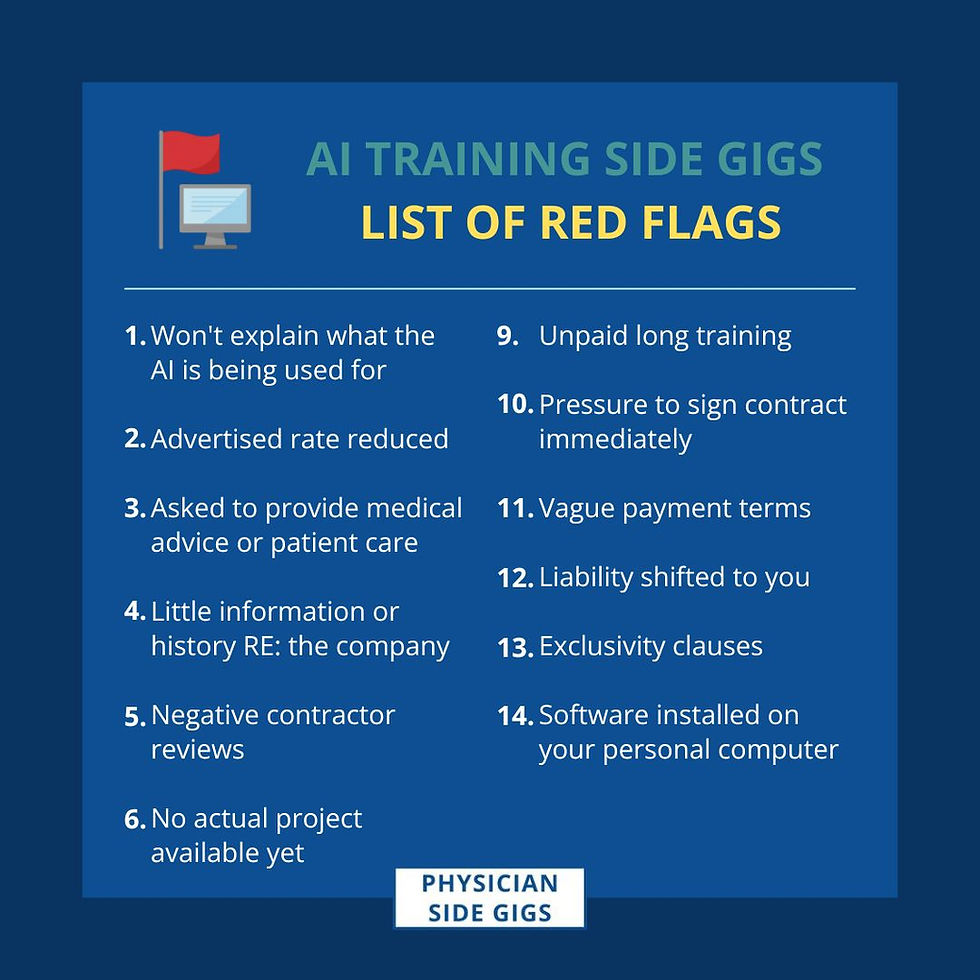
What red flags in AI model training side gigs do I need to be aware of?
Again, there’s a lot to know here, so read our dedicated article on red flags in AI training side gigs.
Which physicians are AI training gigs a good fit for?
It’s really going to depend on:
Your general feelings on AI
Your comfort with technology
Your interests in health technology and innovation
Whether you enjoy reviewing outputs and providing feedback
Whether you enjoy challenging AI models
How much you’re willing to deal with the uncertainty with these projects
How you feel about the hourly rates

In general, these can be a good fit for physicians who are interested in health tech and who want a flexible, remote side gig that pays between $100-200 per hour, and who enjoy being actively engaged in projects during that time. The work is intellectually stimulating, and is not easy, so you have to be prepared for the models to challenge you.
Conclusion
Over the last year, the number of side gig opportunities available to physicians willing to train AI models has exploded. It’s important to understand the gig, as well as ask the right questions and identify red flags, before jumping into them. If it’s a good fit, this can be a great, lucrative, and flexible side gig. We hope this article helped you judge if it’s the right fit for you!
Additional AI related side gig resources for physicians
Sign up for our weekly newsletter for alerts about upcoming AI training projects, as well as our other content, including new blog articles, physician educational webinars, and member resources.
Related PSG resources: