


Red Flags With AI Model Training Side Gigs
- Jul 9
- 8 min read
The need for expertise to train AI models has skyrocketed over the last year, and alongside this need, many vendors looking to fill these projects have entered the arena as both primary labs or middlemen. Vendors who are able to recruit physicians to help train medical models are highly compensated, and therefore, more and more physicians in our online physician communities are being contacted about these opportunities. While these projects can be a great source of side gig revenue for physicians interested in participating in them, it’s important to recognize the risks of rushing into these side gigs without doing some due diligence. The quality and legitimacy of these companies and their clients can vary quite a bit, along with what liability or risk they expose you to. While the companies may encourage urgency, at the end of the day, you still need to protect yourself (financially and legally), your time and energy, your devices, and your privacy. Below, we cover some things to be cautious about based on the experiences of doctors in our communities that have done this work.
Disclosure/Disclaimer: Our content is for generalized educational purposes. While we try to ensure it is accurate and updated, we cannot guarantee it. We are not formal financial, legal, or tax professionals and do not provide individualized advice specific to your situation. You should consult these as appropriate and/or do your own due diligence before making decisions based on this page. To learn more, visit our disclaimers and disclosures.
Article Navigation
What are some red flags I should look for with AI model training side gigs?
Given the speed at which this field is evolving, and how financially incentivized middlemen are to recruit physicians to train AI models in healthcare, it’s important to realize that the hiring companies may not have your experience or protections in mind. As an independent contractor that ultimately has to deal with the risks and consequences of anything that goes wrong, you’ll want to read contracts carefully and ask a lot of questions before accepting an AI training gig. We go over the basic questions you should be asking before taking an AI training gig separately, but focus specifically on red flags in this article.
Red flags in AI model training side gigs based on how a company describes the job
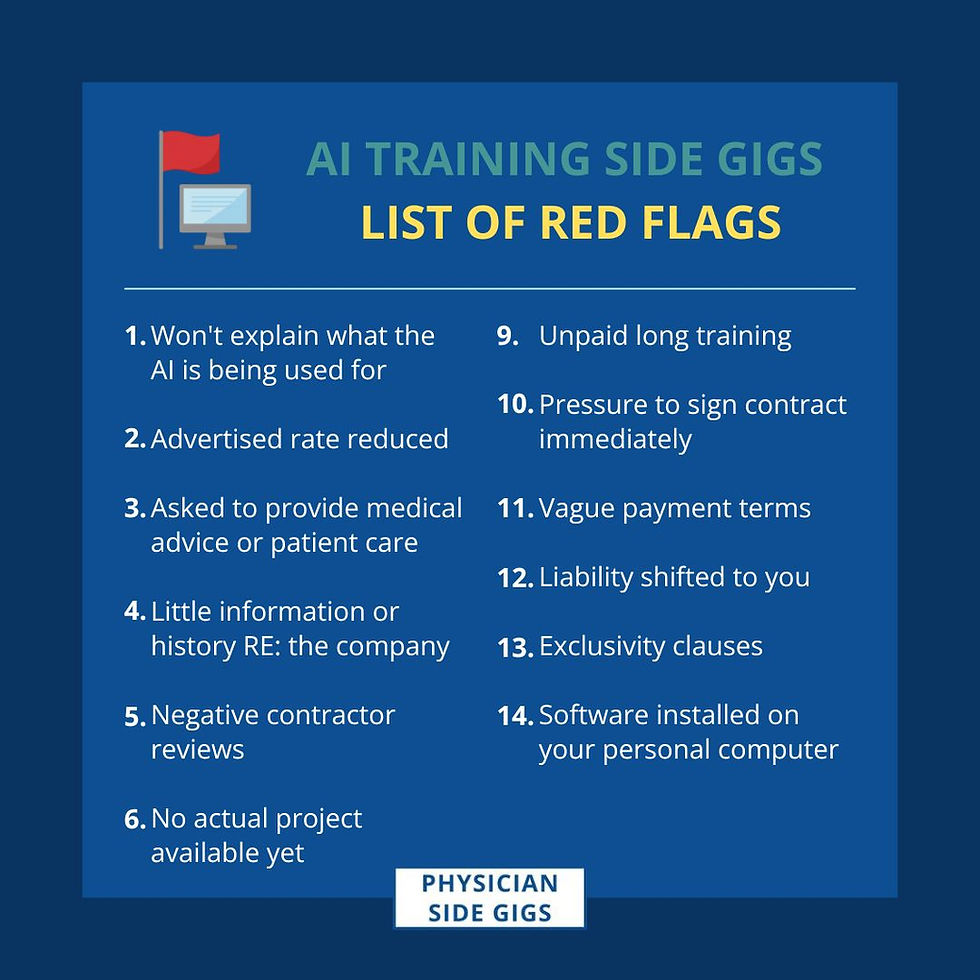
A refusal to tell you what your work will actually be used to do
While we understand the need for confidentiality in this space, a company should be able to tell you what they plan to do with your work product, at least at a high level. This includes things like who the end users are, what type of AI they’re trying to build, and what your exact role is. Almost all companies make you sign some sort of confidentiality agreement or NDA, but don’t give them your SSN or sign anything blindly before you are sure you want to be a part of what they’re doing.
Overly ambitious compensation claims or commitments
Everybody’s competing for talent right now, and we’ve seen a lot of advertisements saying things like, “up to $500/hour” and then actually having it be $125/hour once they start talking to you. Similarly, be wary of anybody that makes promises in this space. These projects move quickly and projects that say they’re going to last for a year get shut down in a week. Honest vendors know this, and will be upfront about that instead of just luring you in with promises of huge compensation. If it sounds too good to be true, it likely is. In general, good companies will warn you that project timelines, requirements, and compensation in this space tend to swing.
Situations that involve giving personalized medical advice or participating in medical care
Be very careful about anything where you’re getting involved in actual patient care, such as providing diagnoses or signing off on diagnoses, or giving personalized recommendations. This is not a model training side gig; this is a medical side gig. The liability and malpractice needed are very different. In AI training model work, you really should just be doing things like reviewing cases, rating responses, labeling, or focusing on educational materials or tasks.
Red flags in AI model training side gigs based on the company itself
Very new companies, or about whom you can’t find any reputable information about online
If the company is a very new company, or if you’ve never heard of the company and can’t find others that have either, be careful. The projects that come from more established AI companies, healthcare technology firms, academic institutions or collaborations, or medical publishers will likely have clearer governance in place with stronger privacy protection, approved technology, and quality control. They’ll also be more protective of their reputation in the space than the newer companies that are just seeking rapid work at the lowest possible cost. You will likely also feel better that you’ll actually get paid!
Searching online reveals bad experiences from other contractors
Always do a search online about the companies, and/or ask about them in our online physician communities. Be very wary of reviews from anybody that asks you to contact them for a referral link, as these referral fees are often large, and people may not be honest about their experiences because they’re trying to make money from having you join. Pay attention to bad experiences with payments, data leaks, projects starting and stopping, lowering rates from promised rates, etc.
Recruiting you when there are no actual projects for you currently in place
Some of these companies don’t yet have actual projects, but are trying to get them, and need to be able to show that they have doctors available to fulfill them. Similarly, projects in this space can start and stop very quickly, sometimes within hours, and they may want to be able to deploy quickly. While it’s part of the nature of the industry, you want to make sure that they have volume or history of volume that makes you confident that you’re onboarding for a reason. While it’s in their best interest to have you on deck, you don’t want to give them all of your personal information and spend time training with them if there’s no actual earning potential.
Red flags in AI model training side gigs based on the contract

Unpaid training hours
Training for these gigs can take many hours. Some are upwards of 10, and can last indefinitely if they feel you need more training or polish before accepting you for a project. During this time, you’re often still training their models as you interact with them. It’s our opinion that you should be paid for this time.
Requests to start working before a contract is in place or pressure to sign documents
Many of these companies are pressuring physicians to commit without having time to do their due diligence. They’re recruiting fast, and may try to create a scarcity mentality where they say they have hundreds of applicants and you will only get it if you sign immediately. They may hand you a 20 page contract and say things like, “It’s a standard contract and everybody signs it. We don’t change it, just sign today if you want to come on board.” While they may be right that someone will sign it and that these projects do fill fast, you don’t want to regret it. Don’t sit on the contract for weeks, but make sure you take the time to read the contract and ensure you’re comfortable with it.
Similarly, though this seems weird, we’ve seen many examples of physicians being asked to start training before an agreement has been signed. Protect yourself - know that there are many young companies in this space that may get your data or work product before ever entering into any contractual agreement with you. Then they could decide not to hire you, pay you a lower rate, include terms that expose you to liability or leave you vulnerable, or otherwise change terms.
Vague or unclear terms within the contract or the ability to change payment rates
You should know exactly what you’re going to be paid and how, what you’re being asked to do, and the situations in which you can be terminated, as well as what happens in these situations. These companies will often try to pay you less if they find others willing to do the work for cheaper, and you want to make sure that you’re not always being asked to work for less.
Liability being shifted on to you
You have not established doctor patient relationships with those that are using these services, and you have no control over what they do with the data you produce and how it’s applied. You should make sure that no liability is passed on to you. Ask if your name could be associated with the product, make sure the contract delineates what happens if the AI causes harm, and that you are indemnified against any issues. It is generally not a good idea to expose yourself to liability for downstream commercial use that you may not even know about depending on who the end product is being sold to. Make sure that the contract explicitly addresses these issues.
You should also make sure that you don’t have access to identifiable patient data or anything else that may be deemed a HIPAA violation. Be careful about downloading any patient records or receiving spreadsheets or other data with patient identifiers, etc.
Exclusivity
Some labs will require that you don’t work with competing AI labs. Personally, we would push back on this as they usually haven’t made you any promises about how much work you’ll get from them, and have the right to terminate you whenever they want. It would be extremely frustrating to not be able to take on a 20 hour/week contract with another lab if you were only getting a few hours a month with this one.
Overly burdensome intellectual property clauses
Most labs will own all work product you create, but some of them create overly complicated and far reaching clauses that could have consequences for your own intellectual property. Be careful about this and review with a lawyer if necessary.
Other red flags in AI model training side gigs
Technology that needs to be installed on your computer
Because a lot of these projects involve monitoring your workflow or potentially running programs on your computer, you’re going to want to be careful about what you’re giving their software access to. Many physicians in our community have recommended that you buy a separate device for this work, as it can corrupt system files or install malware.
Unclear or unreasonable quality or productivity metrics, or insufficient training/support
As this may be used as an excuse not to pay you, it’s very important that you know exactly how you’re going to be evaluated, what opportunities you’ll have to ask for help if you’re struggling, and what the process is if your work is judged as being lower quality or insufficient.
A lot of these companies will not put a lot of time into training and just tell you to “do your best” and figure it out. Some of these projects are only paid if you hit pass training or complete tasks, and if you’re not given the skills to do so, they lose nothing. However, your time is gone.
Similarly, if your payment stipulates you have to do an unreasonable amount of work an hour, the money may not be worth it. Remember, they’re incentivized to get you to do as much as possible in as short of a time as possible, but you’re building medical models. The quality of the work matters, and your expertise has value.
Conclusion
While there’s many rewarding aspects of working on AI projects and they can be quite lucrative, the young and unpredictable nature of this industry has led to a lot of frustration amongst physicians who are used to a more structured approach to agreements. As you can see, there’s a lot to think about when people are innovating at fast speeds and new companies without established protocols are jumping in daily. We hope this article gives you some things to look out for, and decide whether you think engaging with this work is right for you.
Additional AI related side gig resources for physicians
Sign up for our weekly newsletter for alerts about upcoming AI training projects, as well as our other content, including new blog articles, physician educational webinars, and member resources.
Related PSG resources: