


What to Consider Before Buying Real Estate as a Private Practice
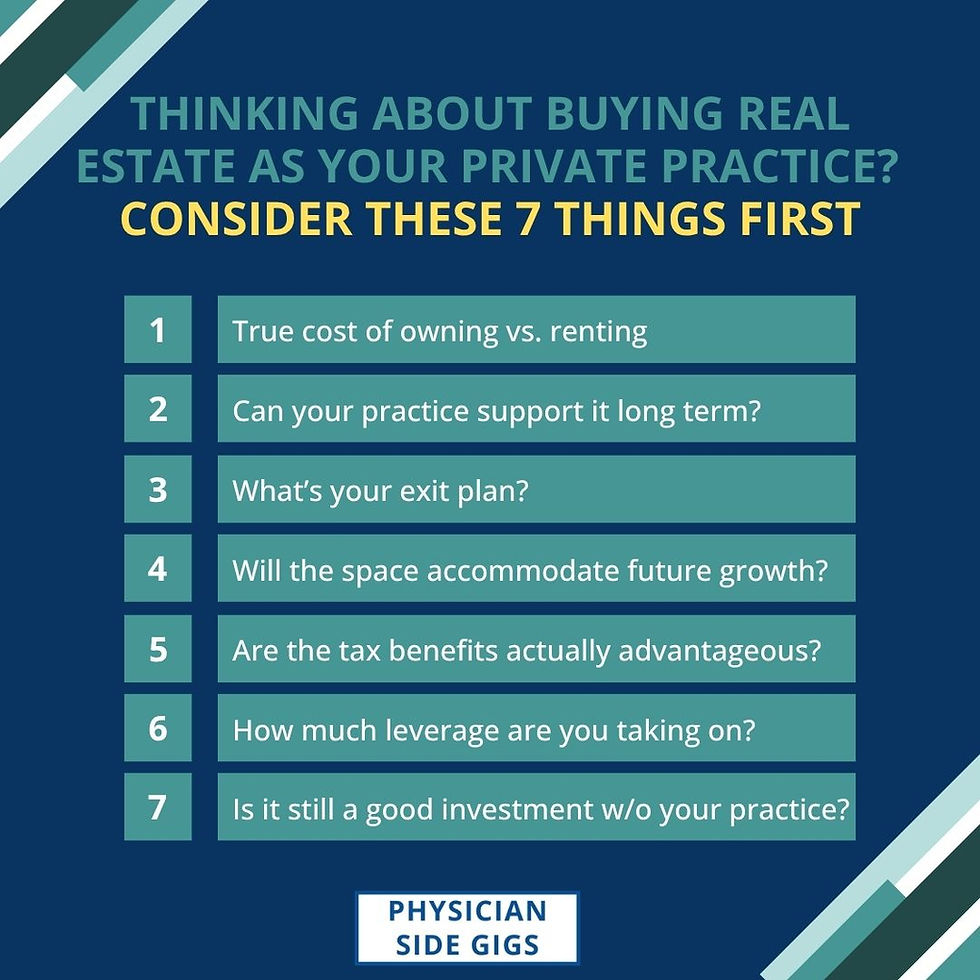
At first glance, owning your own real estate as a private practice may seem like a no brainer. Rent is probably one of your biggest expenses, and the equity and possible tax benefits are attractive and offer passive revenue streams for the partner owners. Because of these factors and others, many physicians in our online communities for doctors advocate for buying buildings whenever possible. That said, the fact is that private practice is not automatically a good idea. It is both a business decision and a real estate investment, and those two objectives can come into conflict, so it’s important to break down the pros and cons before embarking down this pathway. Below, we’ll cover what private practice owners need to know and consider prior to purchasing real estate as a practice.
Disclosure/Disclaimer: This page contains information about our sponsors and/or affiliate links, which support us monetarily at no cost to you. These should be viewed as introductions rather than formal recommendations, and often provide you with perks, so we hope it's win-win. Our content is for generalized educational purposes. While we try to ensure it is accurate and updated, we cannot guarantee it. We are not formal financial, legal, or tax professionals and do not provide individualized advice specific to your situation. You should consult these as appropriate and/or do your own due diligence before making decisions based on this page. To learn more, visit our disclaimers and disclosures.
Article Navigation
How are private practice real estate ownership and private practice ownership usually separated, and what conflicts does that create?
As hard as it may be to do, you have to separate the practice from the property when making the decision to purchase real estate as a private practice.
In most situations, the private practice is a business entity that operates the business and pays the rent, whereas the real estate building is usually a separate entity such as an LLC that owns the building. The private practice signs a lease with the real estate entity.
The reason to do this is not just for asset protection and risk management, but also for cleaner accounting and the ability to own the real estate even if you sell the practice, or vice versa.
In many cases, the ownership of the private practice may not align completely with the ownership of the real estate entity. This can create conflicts of interest where the owners of the building LLC have incentives to charge as much in rent as possible, while the practice will want to keep expenses as low as possible.
You’ll want to work with your attorneys and CPAs to make sure that you do this in a way that is smart.
PSG resources: Attorneys for physicians and accountants for physicians
You can not buy private practice real estate solely based on rent vs. mortgage
Just like when you make the decision to buy a house, you cannot think of the only house expense as the mortgage. Your real cost of ownership includes mortgage principal and interest, property taxes, insurance, repairs and maintenance, landscaping and snow removal, utilities that you are responsible for, HOA/CAM expenses if applicable, major capital expenditures, renovations and tenant improvements, closing costs, financing costs, and the opportunity cost of your down payment. There may also be other things like furnishing the building that you may not have to worry about in some rent situations.
In some cases, if you have a triple net lease, some of these expenses may overlap. But you’ll want to do a true cost analysis and comparison between the costs of renting versus buying before you assume you’ll save money just because the mortgage is cheaper than the rent, or because you’ll be building equity.
Can your practice profits truly support the building long term?
When things are going well for your practice, it’s easy to assume that you’ll always be able to pay the rent. However, remember that this is a long term commitment to pay a mortgage. You’ll want to think about how hard it will be to pay the rent if practice revenue went down by 20-30% for some reason, whether it be secondary to an economic downturn that affects your practice’s profits, retiring partners or employees leaving, CMS or insurance payer cuts, etc.
If the answer to this question causes hesitation or is no, it’s a sign that the property may be too large, too expensive, or too highly leveraged.
Consider what the exit plan is before buying the property
All investments should be purchased with an end game in mind, and you should make sure that your practice’s goals line up with these. Most people assume their practices will be around forever when they buy the building, but you should think about what happens if you sell the practice or if the practice ownership changes in some way. Consider:
Would you sell the practice and the building together
Would you sell the practice and keep the building and lease it to the practice
Would you sell the building separately
Would you have bring in another tenant if the buyer of your practice doesn’t want the building and doesn’t want to lease it from you
What happens when shareholders retire or leave the practice (if you’re not a solo owner, can you still be a part of the real estate ownership, would you get bought out of your shares, etc)
Remember that a building that’s built towards or outfitted towards your practice significantly may not have as much value to another buyer. It may be more difficult to sell or lease it than you think depending on how customized it is. As such, you want to make sure you consider alternative uses to the real estate and the space, as well as other aspects of the real estate that could affect future marketability if you had to put it on the market.
Are you overbuilding for today and/or underbuilding for tomorrow?
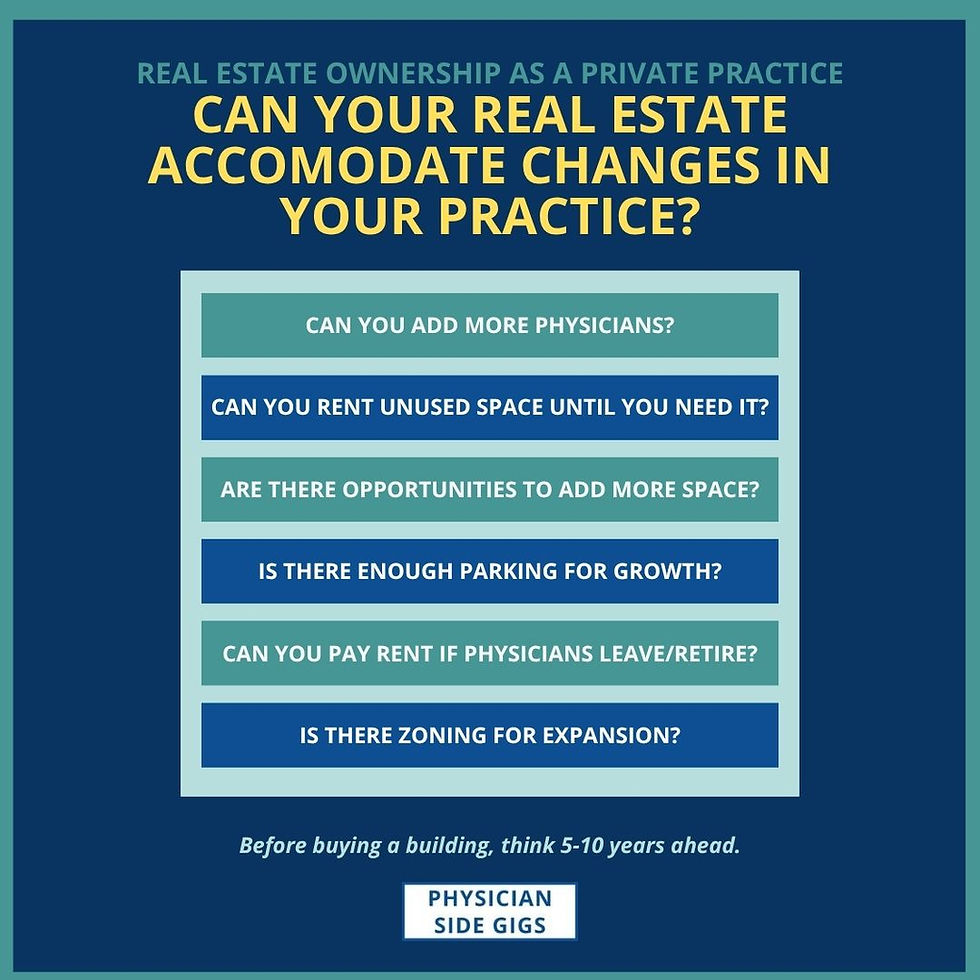
Here’s where you really need to pause and project forward before buying private practice real estate. A real estate purchase is a long term relatively static investment, whereas your practice is a living, growing entity that could go in a lot of directions. Your needs likely will change, and finding a building that can accommodate that change can be challenging.
You’ll need to consider things like:
What happens if we want to hire more physicians or non-physician clinicians?
How much admin space will you need?
Is there a situation where you will need less space (anticipated retirements in the next few years because of partners retiring and no intention to replace, or the use of more telehealth, for example)
Do you want to rent to other healthcare practices, or could you if buy more than you need right now?
Is there enough parking for growth?
Is the zoning appropriate for future expansion plans?
The right building will need to be flexible enough to accommodate these changes. If you don’t think you can find that, or if there’s too much in flux to reliably bet on expansion or needs, you may be better off renting in the short term.
PSG resource: Private Practice Office Space directory for rent
Are the tax implications actually advantageous?
You’ve probably heard ad nauseum how real estate provides tax advantages, but you’ll want to actually model it out. It’s one thing when you own your own short term rental, versus another when the practice owns something or a separate LLC is in place. Depreciation and deductible expenses are good, but remember to consider tax implications for both the practice and the real estate property, and model out depreciation, interest deductions, property taxes, improvements, depreciation recapture at the time of sale, capital gains at the time of sale, how the ownership structure provides or doesn’t provide advantages.
Talking to an experienced account is critical. We have a list of accountants for physicians in case you need help, though the best place to start is likely your practice accountant.
Be very careful and intentional about financing, leverage, and related funding
Funding can be very tricky and/or complicated depending on how the practice is approaching it. While practices may be able to leverage their relationships and resources, you also want to be careful about leveraging the practice in any way for what may be a suboptimal investment or terms that could leave you vulnerable. It’s also going to be very important to figure out how much capital you can come up with between the practice and the partners or owners of the real estate, and what a fair arrangement is. Consider future partners that may also want a piece of the practice real estate. All of this is going to require complicated discussions that should be navigated prior to jumping in. For example, if 2 partners own the real estate and want to keep raising rent, is it going to place the rest of the practice at risk because they’re paying rent that’s higher than what they’d pay on the market?
Evaluate the property like an investor would
When things are going well, it’s easy to say, well, we’ve got a sure tenant, we’re not going to default on rent. That’s great when things are going well, but at the end of the day, if you’re going to own real estate, you need to underwrite the deal the same way you would any other real estate investment. Think about how stable the practice really is, whether the location is actually good if you had to sell it, what cap rates and appreciation look like, how easy it would be to rent and at what rates, etc. Essentially, make sure you’d still want to own the building even if the practice didn’t exist.
Ask yourself if it makes the practice more valuable or desirable to patients
The last thing to consider is whether there’s unique value in owning the property, or whether your practice would do just fine in another building. There is benefit to stability and establishing a foothold in a location where nobody can kick you out or offer the lease to a higher paying tenant, but it goes beyond that. Would the ability to customize this space make the practice more marketable or attractive to patients? Does it offer the ability to build out new business lines or offer your surgeons more flexibility to do more cases because you can put in operating rooms? There’s a lot of things that landlords may regulate, or that local or state laws require that you may want to have control over to confidently build your practice. This has value too.
Conclusion
The decision to invest in practice real estate is not as straightforward as it may sound. You’re going to need to balance the financials, whether the building itself is independently a good deal that you would want to invest in regardless, and what it does for the practice strategically. You’ll need to walk through worst case scenarios and future growth and expansion plans. While practice real estate can be an amazing investment, do the math and consult related expertise, so that you can walk into the decision confidently and with intention.
Related private practice resources for physicians
Sign up for our weekly newsletter for alerts about side gig opportunities, upcoming free webinars, new articles and podcast episodes, additional educational resources, and more.
Related PSG resources: